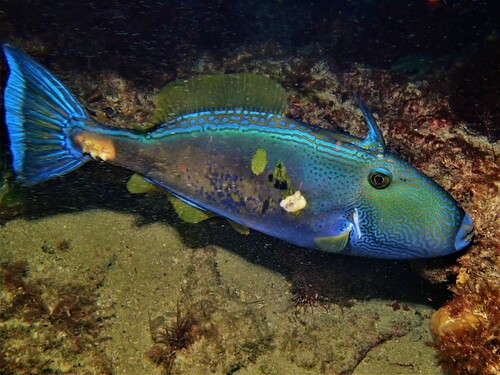
Sixspine Leatherjacket
Meuschenia freycineti
With its sandpaper skin and vibrant orange spots, the Sixspine Leatherjacket is a charismatic icon of the Australian reef. A master of the 'lock-and-hide' defense, this inquisitive fish is a favorite for underwater backyard observers.
Quick Identification
Size
Grows up to 60 cm (24 inches) in length and can weigh up to 1.5 kg (3.3 lbs)
Colors
Highly dimorphic; males are vibrant with greenish-blue bodies and bright orange spots or lines, while females are yellowish-brown with dark horizontal stripes.
Key Features
- Retractable large dorsal spine above the eyes
- Six distinct spines on the base of the tail (males)
- Rough, sandpaper-like skin texture
- Deep, compressed body shape
- Small, powerful beak-like mouth
When You’ll See Them
Geographic range
Where Does the Sixspine Leatherjacket Live?
This species is native to the temperate waters of the Australian continent. Its primary range extends along the southern half of the country, from the southern waters of Queensland down through New South Wales, Victoria, and Tasmania, stretching westward to the coast of Western Australia. They are a staple resident of the Great Southern Reef, thriving in cool to sub-tropical coastal environments.
Basemap © OpenStreetMap contributors
Behavior
The Sixspine Leatherjacket is a curious and relatively bold species often found navigating the temperate reefs of Australia. Unlike many skittish reef fish, they are known to be inquisitive, frequently approaching divers or stationary underwater cameras to investigate their surroundings. They swim with a unique, graceful motion, using their dorsal and anal fins to maneuver precisely through complex kelp forests and rocky crevices.
These fish are largely solitary but are occasionally seen in pairs, especially during the breeding season. They possess a fascinating defense mechanism: when threatened, they retreat into a hole and lock their large primary dorsal spine upright. This wedges them firmly into the reef, making it nearly impossible for a predator to dislodge them. In the context of human interaction, they are notorious "bait thieves" for jetty fishers, using their sharp teeth to nibble bait off hooks without being caught.
EverydayEarth exclusive
Camera Tips
Capturing the Sixspine Leatherjacket requires an underwater camera setup. For those with coastal properties or access to jetties, a weighted action camera (like a GoPro) or a specialized underwater trail cam can be dropped near reef edges or seagrass boundaries. Because they are diurnal, you’ll get the best results by recording during the brightest part of the day; the sunlight helps highlight the brilliant orange and blue markings of the males that would otherwise appear grey in deep water.
To draw them into the frame, use a bait cage. A simple mesh bag filled with crushed sea urchins, pipis, or oily fish scraps works wonders. These fish are highly visual and inquisitive, so a shiny object or the camera lens itself often attracts them. Position the camera at a height of about 30-50cm off the seafloor, angled slightly upward toward the reef structure to capture their natural foraging behavior.
For camera settings, use at least 60fps at 4K resolution. This allows you to slow down the footage to observe the hypnotic undulation of their fins. If you are filming near a jetty where the water might be murky, use a red color filter to bring back the warm tones of the fish’s markings. Be sure to secure your camera with a safety tether, as these curious fish have been known to peck at loose straps or shiny mounting screws.
Frequently Asked Questions
Record Sixspine Leatherjacket at your habitat
Connect a camera to start building your own species record — AI identifies every visitor automatically.