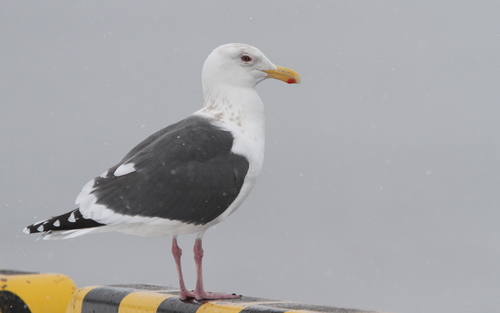
Slaty-backed Gull
Larus schistisagus
A majestic wanderer of the North Pacific, the Slaty-backed Gull is easily recognized by its dark charcoal back and striking pink legs. This intelligent seabird travels thousands of miles from Siberian coasts to North American shorelines every winter.
Quick Identification
Size
Length: 55–67 cm (22–26 in); Wingspan: 132–160 cm (52–63 in); Weight: 1,050–1,800 g (2.3–4.0 lbs)
Colors
Adults have a dark slaty-gray mantle and wings, white head and underparts, and bright pink legs. The wingtips show a unique 'string of pearls' white pattern. Males and females are identical in plumage.
Key Features
- Dark slaty-gray back and wings
- Bright pink legs and feet
- White 'string of pearls' spots near wingtips
- Large yellow bill with a prominent red spot
When You’ll See Them
Geographic range
Where Does the Slaty-backed Gull Live?
Native to the Palearctic region, the Slaty-backed Gull primarily breeds along the northeastern coasts of Asia, including Russia's Kamchatka Peninsula, the Sea of Okhotsk, and northern Japan. During the winter, their range expands significantly as they migrate south to the coasts of China, South Korea, and Taiwan. In recent decades, they have become a regular winter visitor to the Pacific coast of North America, with frequent sightings ranging from Alaska down to California, and occasional rare appearances at inland reservoirs and the Great Lakes.
Basemap © OpenStreetMap contributors
Behavior
The Slaty-backed Gull is a powerful and assertive seabird known for its opportunistic nature. In their breeding colonies along the rocky coasts of the Pacific, they are highly social and vocal, using a variety of loud, raucous calls to defend nesting sites and communicate with mates. Like many large gulls, they are intelligent problem-solvers, often observed dropping hard-shelled mollusks onto rocks or pavement to break them open.
During the non-breeding season, these gulls become nomadic wanderers. While they are primarily coastal, they have learned to thrive alongside human activity. They are frequent visitors to commercial fishing ports and landfills, where they compete aggressively with other gull species for scraps. Despite their size and power, they are generally wary of direct human contact but will comfortably inhabit suburban shorelines and industrial waterfronts where food is plentiful.
EverydayEarth exclusive
Camera Tips
To capture high-quality footage of a Slaty-backed Gull, focus your camera placement on high-vantage points near water or known feeding areas. If you live near a coastline or a large estuary, placing your camera on a fence post or a stable pier railing can provide the eye-level perspective that makes for stunning wildlife photography. These birds are most active during the early morning hours when the tide is receding, exposing tide pools and easy foraging ground.
Because of their white plumage and dark 'slaty' backs, these gulls can be a challenge for auto-exposure settings. On sunny days, the white feathers often 'blow out' or lose detail. If your camera allows, try to set a slightly negative exposure compensation or aim the camera so the bird isn't in direct, harsh midday sun. Using a fast shutter speed is essential if you want to capture their impressive wingspan in flight, as they are surprisingly fast and agile for their size.
While we don't recommend baiting wildlife, you can increase your chances of a sighting by setting up your camera near natural attractants like fish processing docks or rocky outcrops where gulls naturally congregate to preen. For those in suburban coastal areas, a bird bath or a freshwater source on a flat roof can sometimes attract these large gulls, as they need to wash salt from their feathers regularly. Ensure your camera is angled slightly upward if placed on the ground, or level with the bird's eye if mounted on a structure, to capture the distinctive 'string of pearls' pattern on their wingtips.
Similar Species
Species that look similar or are commonly confused with Slaty-backed Gull.
Western Gull
Western Gulls have a slightly darker mantle and lack the 'string of pearls' wing pattern found in Slaty-backeds.
Glaucous-winged Gull
Much paler gray wings that match the color of their primary feathers, whereas the Slaty-backed has dark wings with black tips.
Lesser Black-backed Gull
Easily distinguished by their bright yellow legs, whereas Slaty-backed Gulls always have pink legs.
Frequently Asked Questions
Record Slaty-backed Gull at your habitat
Connect a camera to start building your own species record — AI identifies every visitor automatically.