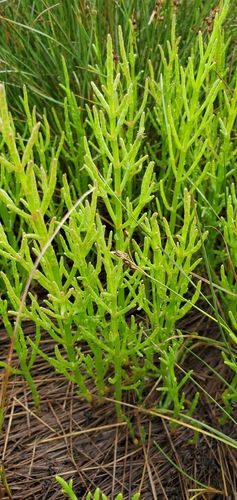
slender glasswort
Salicornia maritima
Meet the resilient 'sea bean' that paints our coastlines in shades of fire. Slender glasswort is a salt-loving succulent that thrives where the land meets the sea, offering a spectacular autumn color show.
Quick Identification
Size
Typically 10–50 cm (4–20 inches) in height with a spread of 15–30 cm (6–12 inches).
Colors
Bright, translucent green in spring and summer; transforms to vibrant crimson, ruby red, or deep orange in autumn.
Key Features
- Succulent, jointed stems resembling miniature asparagus
- Scale-like leaves that appear as small ridges at stem joints
- Lack of visible petals; flowers are tiny and embedded in the stem
- Turns brilliant red in late summer and fall
- Salty, crunchy texture
When You’ll See Them
Behavior
As an annual species, its life cycle is a race against the seasons. It germinates in the spring from seeds deposited by the previous year's tides. Throughout the summer, it stays low and green, providing a crucial micro-habitat for salt-marsh snails and juvenile crabs. In the autumn, the plant undergoes a dramatic physiological change, producing red pigments called anthocyanins. This 'reddening' is a response to both the cooling air and the accumulation of salt, creating the famous 'red marshes' of the Atlantic coast.
EverydayEarth exclusive
Camera Tips
Capturing the slender glasswort requires a different approach than moving wildlife. Because this species is stationary and lives in the harsh intertidal zone, your primary challenge is environmental protection. Use a salt-resistant stake or a heavy-weighted tripod to mount your camera about 12 inches above the marsh floor. Ensure your equipment is housed in a high-quality waterproof casing, as the coastal air is corrosive and tidal surges can be unpredictable.
For the most striking visuals, focus on time-lapse photography. Set your AI camera to take a high-resolution image once every day at the same time (noon is usually best for consistent lighting). By starting this process in August and continuing through October, you can create a stunning sequence of 'The Great Reddening,' documenting the plant’s transition from sea-foam green to fiery crimson. This provides a beautiful record of the changing seasons in your local ecosystem.
Lighting is critical for highlighting the succulent texture of the glasswort. Use the 'golden hour'—shortly after sunrise or before sunset—to capture side-lighting that makes the fleshy, translucent stems appear to glow. If your camera allows for macro settings, position the lens within 18 inches of a healthy cluster to capture the intricate, jointed segments and the tiny, bead-like flowers that are often missed by the naked eye.
Frequently Asked Questions
Record slender glasswort at your habitat
Connect a camera to start building your own species record — AI identifies every visitor automatically.