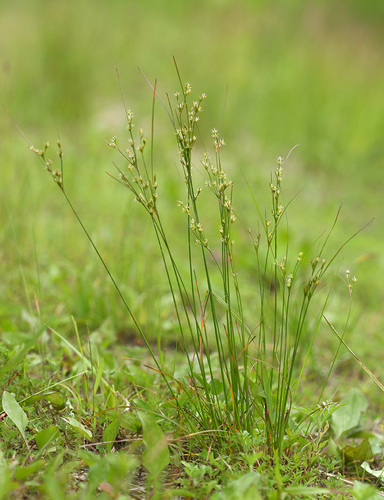
Slender Path Rush
Juncus tenuis
The unsung hero of the garden path, Slender Path Rush turns compacted soil into a vibrant green corridor. It is a master of resilience, thriving exactly where we walk.
Quick Identification
Size
Stems reach 15 to 60 cm (6 to 24 inches) in height; clumps typically span 10 to 30 cm (4 to 12 inches) wide.
Colors
Bright emerald green stems and leaves; matures to a tan or straw-brown in autumn with small brownish seed capsules.
Key Features
- Round, solid stems that feel wiry to the touch
- Two long, leaf-like bracts that extend significantly past the flower cluster
- Dense, clump-forming growth habit
- Extremely resilient to foot traffic and soil compaction
When You’ll See Them
Behavior
Slender Path Rush is a remarkable survivor that specializes in growing where most other plants cannot: compacted, high-traffic soil. Often found lining the very center of forest trails or the edges of gravel driveways, it has earned its name by thriving under the literal weight of human and animal footsteps. Unlike grasses, which have flat blades, this rush has round, tough stems that resist snapping when stepped on.
This plant plays a quiet but vital role in the ecosystem by stabilizing soil in disturbed areas and preventing erosion on footpaths. It produces inconspicuous greenish-brown flowers in the late spring, which eventually turn into sticky seed capsules. These seeds are a masterpiece of biological engineering, becoming gelatinous when wet so they can glue themselves to the fur of animals or the boots of hikers to be transported to new locations.
EverydayEarth exclusive
Camera Tips
To successfully document Slender Path Rush with an AI-powered camera, placement is everything. Since this plant rarely exceeds two feet in height, you should mount your camera on a low-profile ground stake or a small tripod only 6 to 12 inches off the ground. Aim the lens at a 45-degree downward angle to capture the star-shaped flower clusters and the distinctive long bracts that are essential for accurate AI identification.
Because plants don't move fast enough to trigger standard motion sensors, use your camera's 'Time-Lapse' mode. Setting the camera to take a photo every 30 minutes during the spring can create a stunning visual record of its growth and the opening of its seed pods. This method also allows you to see how the plant reacts to weather—its stems often bowing during heavy rain and springing back once dry.
Keep an eye on the area surrounding the rush for 'bycatch' wildlife. Slender Path Rush acts as a micro-habitat for ground-dwelling insects like carabid beetles and spiders. If your camera has a high-sensitivity mode, you might capture these tiny predators moving through the 'forest' of green stems. For the best image quality, clear away any tall, stray blades of common grass that might blow in front of the lens and cause false triggers or blur the focus on the rush itself.
During the autumn, the tan seed heads become a point of interest for small ground-feeding birds like juncos or sparrows. Position your camera near a well-established clump during the morning hours (6-9 AM) to catch these birds foraging for seeds or the insects that hide within the clump. If the soil is wet, you may even capture the moment seeds adhere to a passing animal's fur, showcasing the plant's unique dispersal strategy.
Frequently Asked Questions
Record Slender Path Rush at your habitat
Connect a camera to start building your own species record — AI identifies every visitor automatically.