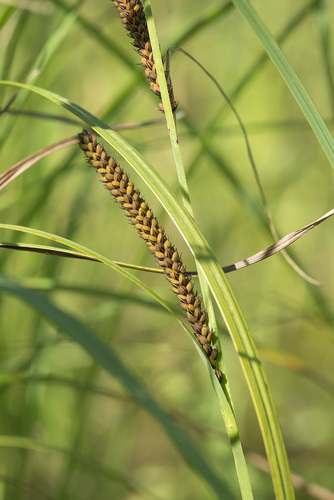
slender tufted-sedge
Carex acuta
An elegant, moisture-loving perennial that forms iconic green mounds along the water's edge. Slender tufted-sedge is the perfect blend of structural beauty and ecological utility for any backyard wetland.
Quick Identification
Size
30–150 cm (1–5 feet) tall with a spread of 30–60 cm (12–24 inches) per tussock
Colors
Bright green to glaucous foliage; dark brown to nearly black flower spikes
Key Features
- Triangular stems with noticeably sharp edges
- Long, drooping flower spikes (3–10 cm)
- Dense, mounded growth habit (tussocks)
- Leaf-like bracts that extend beyond the flower clusters
When You’ll See Them
Behavior
Slender tufted-sedge is a hardy perennial that thrives in the transition zones between land and water. Unlike many garden grasses, it grows in distinct, dense mounds known as tussocks. These mounds are formed by the plant’s tight growth pattern and persistent root system, which can live for many years. In the wild, these tussocks provide critical micro-habitats, acting as dry islands for insects and small creatures during high water levels.
Environmentally, this species is a stabilizer. Its extensive rhizome system binds soil together, preventing erosion along riverbanks and pond edges. While it does not move like an animal, it reacts dynamically to the seasons, with its foliage turning from a vibrant green in spring to a golden-brown in autumn, and finally collapsing in winter to provide a protective mulch layer for the soil and hibernating invertebrates.
EverydayEarth exclusive
Camera Tips
To capture the best images of slender tufted-sedge, focus on its architectural silhouette. Place your AI-powered camera on a low tripod or a ground stake, roughly 12 inches above the water line. Angle the lens slightly upward to emphasize the height of the flower spikes against the open sky. Because this plant is often found near water, a low-angle shot can also capture beautiful reflections of the green foliage on the water's surface, doubling the visual impact of your footage.
Timing is everything for botanical photography. Set your camera to record during the "golden hours" of sunrise or sunset. The low-angled light will catch the fine hairs and glumes of the flower spikes, making them appear to glow against darker backgrounds. Since this is a stationary subject, it’s an excellent candidate for time-lapse settings. Try capturing one frame every 15 minutes over a week in late May to document the rapid emergence and drooping of the heavy seed heads.
One of the biggest challenges with sedges is wind-induced motion, which can cause hundreds of false triggers on motion-sensing cameras. To solve this, lower the motion sensitivity in your camera settings or use a "masking" feature to ignore the very top of the plant where swaying is most extreme. Alternatively, embrace the movement! Slow-motion video of slender tufted-sedge swaying in a summer breeze can be incredibly peaceful and highlights the "slender" nature of its stems.
Finally, use the sedge as a natural frame for other backyard wildlife. Position your camera so the tufts are in the foreground (slightly out of focus) while aiming at a nearby birdbath or a known frog-resting spot. This creates a professional-looking "depth of field" effect. In the winter, keep the camera rolling; the dried, frost-covered stems of the sedge provide a striking crystalline structure that looks fantastic in high-resolution photos, especially when visited by small birds looking for leftover seeds.
Frequently Asked Questions
Record slender tufted-sedge at your habitat
Connect a camera to start building your own species record — AI identifies every visitor automatically.