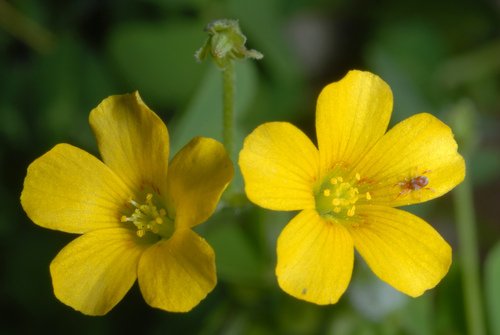
slender yellow woodsorrel
Oxalis dillenii
Look closely at your lawn and you might find the slender yellow woodsorrel, a fascinating plant with heart-shaped leaves that 'sleep' at night. Known for its bright yellow blooms and exploding seed pods, it is a master of survival in the backyard landscape.
Quick Identification
Size
2 to 8 inches (5–20 cm) tall; leaflets 0.4 to 0.8 inches (1–2 cm) wide
Colors
Bright lemon-yellow flowers; vibrant green foliage; seed pods are brownish-green
Key Features
- Three heart-shaped leaflets per leaf
- Five-petaled yellow flowers, 4-10mm wide
- Upright seed capsules that point skyward
- Stems covered in tiny, pressed-down hairs
- Leaves fold downward at night or during rain
When You’ll See Them
Behavior
Slender yellow woodsorrel is a resilient and opportunistic plant often found tucked into the edges of garden beds or scattered across lawns. Unlike the rounded leaves of true clover, this plant features distinct heart-shaped leaflets that help it stand out. It is best known for its 'nyctinastic' movements, a process where the leaves fold downward and close up tight at night or during heavy cloud cover, effectively going to sleep to protect the plant's surfaces and conserve moisture.
This species is also famous for its explosive method of reproduction. As the seed pods dry and reach maturity, they become highly pressurized. The slightest vibration—from a passing animal, a raindrop, or a gardener’s footstep—causes the pod to burst violently, flinging tiny seeds several feet away. While many consider it a common garden weed, it provides a vital nectar source for small native bees and butterflies early in the season.
EverydayEarth exclusive
Camera Tips
To get the best shots of slender yellow woodsorrel, you need to bring your camera down to its level. Use a ground-stakes mount or a very low-profile tripod to position your lens just a few inches from the soil. This 'bug's-eye view' highlights the intricate details of the five-petaled yellow flowers and the unique heart shape of the leaves, which can look flat and uninteresting from a standing height.
One of the coolest ways to use an AI-powered or trail camera with this species is to set up a time-lapse. Because the leaves fold up at night and open during the day, a time-lapse captured over 24 hours (with a frame taken every 10–15 minutes) creates a stunning visual of the plant 'waking up.' For the best clarity, choose a patch that receives bright, filtered morning light. Direct midday sun can often overexpose the bright yellow petals, making them look like featureless white blobs in your photos.
If your camera has a high-speed video mode, try aiming it at a cluster of brown, mature seed pods. These pods are the ones most likely to 'explode.' While it's difficult to time the exact moment of seed dispersal, you can sometimes trigger the action by gently misting the plant with a garden hose from a distance, simulating a rainstorm. This provides a rare opportunity to capture the physics of seed catapulting in slow motion, a feature that is a huge hit on community wildlife galleries.
Similar Species
Species that look similar or are commonly confused with slender yellow woodsorrel.
Frequently Asked Questions
Record slender yellow woodsorrel at your habitat
Connect a camera to start building your own species record — AI identifies every visitor automatically.