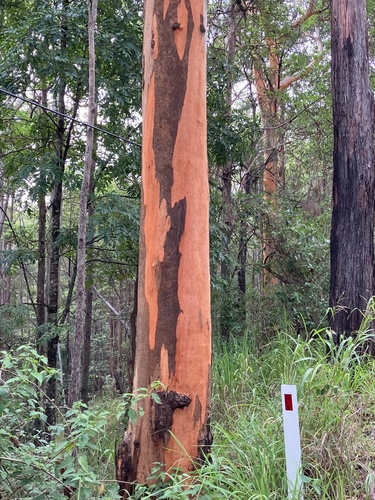
Small-fruited Grey Gum
Eucalyptus propinqua
With its stunning mottled bark and status as a favorite snack for Koalas, the Small-fruited Grey Gum is an Australian icon. It serves as a bustling high-rise apartment for some of the continent's most beloved birds and marsupials.
Quick Identification
Size
Medium to tall tree reaching 30–45 metres (98–148 feet) in height with a trunk diameter up to 1 metre (3.3 feet).
Colors
Smooth bark mottled in patches of grey, cream, and matte orange or reddish-brown; adult leaves are dark green above and distinctly paler below.
Key Features
- Smooth, matte bark that sheds in irregular patches to reveal colorful new layers
- Lance-shaped leaves that are 'discolourous' (darker on top, paler underneath)
- Small, conical or hemispherical fruits measuring only 3–5 mm in diameter
- Flower buds arranged in distinct clusters of seven to fifteen
When You’ll See Them
Geographic range
Where Does the Small-fruited Grey Gum Live?
Native to the eastern coast of Australia, the Small-fruited Grey Gum is found in a relatively narrow band stretching from the Wyong district in New South Wales up into southeastern Queensland, reaching as far north as Maryborough. It is a common sight throughout the Great Dividing Range's eastern slopes, where it thrives in the subtropical and temperate transition zones. While not widely naturalized outside of Australia, it is a dominant feature of the coastal hinterlands within its native territory.
Basemap © OpenStreetMap contributors
Behavior
Ecologically, this tree is a high-value provider. It follows a seasonal flowering pattern, typically bursting into white blooms during the summer months, which triggers a frenzy of activity among local pollinators. It is a long-lived species, and as it matures, it naturally develops hollows that become essential real estate for nesting birds, microbats, and arboreal marsupials. In the wild, it often grows in tall, open forests where it competes for canopy space, yet it remains surprisingly resilient to the fluctuating weather patterns of the Australian coast.
EverydayEarth exclusive
Camera Tips
For those interested in the tree's unique bark, set your camera to time-lapse mode during the late spring and early summer. By taking one photo every 24 hours, you can create a stunning sequence showing the old grey bark peeling away to reveal the bright, matte orange layers beneath. Ensure the camera is secured tightly to a neighboring tree to prevent wind-shake from ruining the alignment of your time-lapse.
Nighttime is when this tree truly comes alive for wildlife enthusiasts. Use a high-quality infrared flash to capture the Sugar Gliders and Feathertail Gliders that frequent the Small-fruited Grey Gum for its sap and nectar. If your camera has a 'fast shutter' or 'blur reduction' setting, enable it, as gliders move incredibly fast. Aim your lens toward the flowering clusters if they are within reach, as this is where the nocturnal action is most concentrated.
Don't forget the base of the tree. Many ground-dwelling species, such as Bandicoots and Lyrebirds, forage in the rich leaf litter and shed bark that accumulates at the foot of a Grey Gum. Position a second camera about 30cm off the ground, roughly 3 metres back from the trunk, to capture these 'basement' residents in their natural habitat.
Frequently Asked Questions
Record Small-fruited Grey Gum at your habitat
Connect a camera to start building your own species record — AI identifies every visitor automatically.