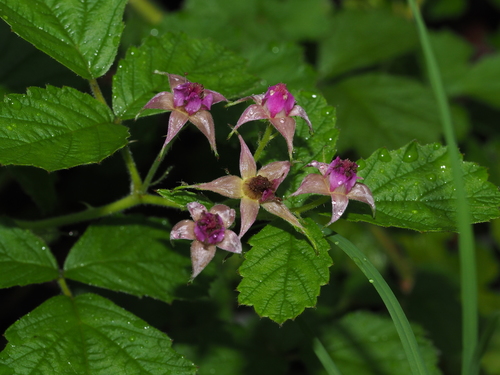
small-leaf bramble
Rubus parvifolius
A hardy and beautiful native raspberry, the small-leaf bramble offers a stunning display of pink flowers and ruby-red berries. It is a vital sanctuary for pollinators and a favorite snack for backyard birds.
Quick Identification
Size
A scrambling shrub with stems reaching up to 2 meters (6.5 feet) in length, typically standing 30 to 100 centimeters (1-3 feet) tall.
Colors
Bright green leaves with distinct silvery-white hairy undersides; flowers are pink to reddish-purple; fruit is a glossy, translucent red.
Key Features
- Leaves usually divided into three rounded, wrinkled leaflets
- Stems feature small, downward-curved prickles
- Small, five-petaled pink flowers that appear clustered
- Edible bright red aggregate fruit resembling a small raspberry
When You’ll See Them
Behavior
The small-leaf bramble is a resilient, scrambling shrub that spreads through a combination of arching stems and bird-dispersed seeds. Unlike many garden raspberries that grow upright, this species often trails along the ground or climbs over low-lying debris, creating dense thickets that provide excellent cover for ground-dwelling birds and small mammals. It is a slow but steady grower, often establishing itself in the dappled light of forest edges or suburban garden borders.
For humans, the plant is a delightful discovery in the backyard, offering edible—though often tart—berries during the summer months. It interacts beautifully with the local ecosystem; its flowers are a magnet for native bees and butterflies, while the fruit is a high-energy resource for birds. While it can be vigorous, it is generally less aggressive than its cousin, the common blackberry, making it a more manageable addition to a wildlife-friendly landscape.
EverydayEarth exclusive
Camera Tips
Capturing the small-leaf bramble on a trail camera is best approached by focusing on the 'wildlife hub' the plant creates. Position your camera on a small tripod or mount it low to the ground, roughly 12-18 inches high, aimed directly at a cluster of ripening berries. Because the fruit attracts a variety of birds and small mammals, this low angle provides an intimate view of the feeding behavior that higher placements miss.
To capture the stunning contrast of the plant's leaves, try to angle your camera so it catches the morning or late afternoon sun. This lighting highlights the distinctive silvery-white undersides of the leaves and makes the red berries appear to glow in the frame. If your camera has a macro or close-focus setting, use it to ensure the intricate texture of the fruit and the delicate pink flowers are sharp.
For those interested in the plant's life cycle, set your camera to time-lapse mode during the peak flowering season. A shot every 30 minutes over the course of two weeks can beautifully document the transition from bud to flower to fruit. Ensure your camera is well-secured, as the bramble's thorns can snag on equipment if the wind blows the stems across the lens. Clearing a small 'window' in the foliage directly in front of the lens will prevent unwanted motion triggers from swaying branches.
Frequently Asked Questions
Record small-leaf bramble at your habitat
Connect a camera to start building your own species record — AI identifies every visitor automatically.