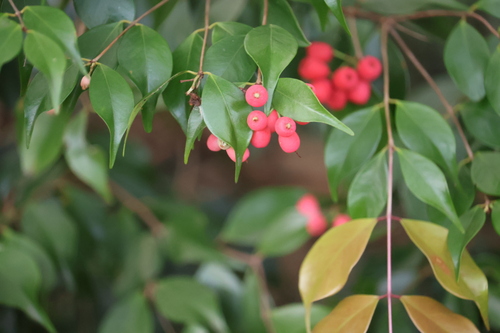
Small-leaved Lilly Pilly
Syzygium luehmannii
A stunning Australian native famous for its vibrant pink new growth and edible red 'riberries.' This lush rainforest tree is a bustling wildlife hub, providing food and shelter for dozens of bird and mammal species.
Quick Identification
Size
A medium-sized tree reaching 10–30 metres (33–100 feet) in rainforests, but typically 5–10 metres (16–33 feet) in suburban gardens.
Colors
Glossy dark green mature leaves; vibrant pink, bronze, or red new growth flushes; bright red or cranberry-colored pear-shaped berries.
Key Features
- Small glossy leaves (4–5cm) with a distinct long-pointed tip
- Bright red pear-shaped berries (riberries) appearing in summer
- Dense, weeping canopy with multi-colored new foliage
- Small white or cream fluffy flowers with numerous stamens
When You’ll See Them
Geographic range
Where Does the Small-leaved Lilly Pilly Live?
Native to the Australian continent, the Small-leaved Lilly Pilly is primarily found along the eastern coastline. Its core range extends from the tropical regions of North Queensland down through the temperate coastal forests of New South Wales. While its natural habitat is the rainforest, it has become a ubiquitous sight in suburban landscapes across almost every Australian state due to its hardy nature and attractive foliage.
Basemap © OpenStreetMap contributors
Behavior
The Small-leaved Lilly Pilly is a cornerstone of the Australian coastal rainforest ecosystem, known for its rapid growth and dense, evergreen foliage. It exhibits a spectacular 'flush' of new growth several times a year, where the entire canopy turns shades of brilliant pink and red before maturing into a deep, glossy green. This serves as a natural signal to local wildlife that the tree is in an active growth phase.
During the late spring and early summer, the tree produces a profusion of small, white, nectar-rich flowers that attract a wide variety of pollinators, including native bees and butterflies. These are followed by large clusters of edible red berries, often called 'riberries,' which hang heavily from the branches. In a suburban context, this tree is highly social, often planted as a privacy screen or hedge where it provides essential nesting sites for small birds seeking protection from larger predators.
EverydayEarth exclusive
Camera Tips
To capture the best wildlife activity, position your AI camera to focus on a heavy cluster of ripening red berries. Because the Small-leaved Lilly Pilly is a magnet for fruit-eating birds like King Parrots, Crimson Rosellas, and Figbirds, setting your camera at a height of 5 to 8 feet (aiming upward into the lower canopy) will provide the most intimate shots of feeding behavior. Ensure the camera is mounted on a stable branch or a nearby fence post to minimize wind-induced false triggers from the tree's dense foliage.
Lighting is crucial when photographing this species because its leaves are exceptionally glossy. Direct midday sun can cause harsh glares that wash out the vibrant reds of the riberries. Try to angle your camera so it faces North or South, catching the softer morning and late afternoon light which makes the pink new growth 'glow.' If your camera has adjustable sensitivity, set it to a higher level during the early morning hours (6 AM to 9 AM) when bird activity is at its peak.
In the evening, the Small-leaved Lilly Pilly becomes a hub for nocturnal mammals. If you are using a trail camera with infrared night vision, place it near the trunk or along a main 'highway' branch. You are likely to capture Common Brushtail Possums or even Grey-headed Flying Foxes climbing through the branches to reach the fruit. During the summer fruiting peak, consider using a faster shutter speed or 'burst mode' to capture the rapid movement of birds fluttering between branches.
Frequently Asked Questions
Record Small-leaved Lilly Pilly at your habitat
Connect a camera to start building your own species record — AI identifies every visitor automatically.