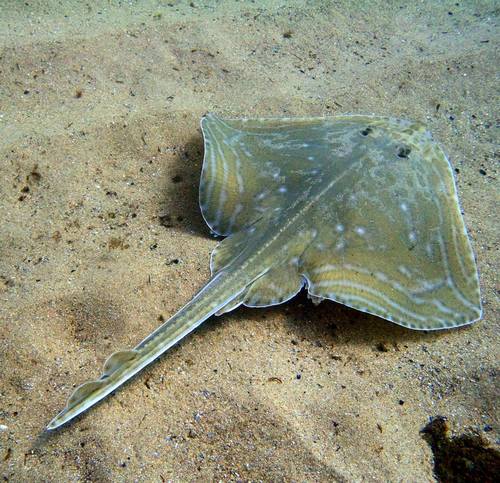
Smalleyed Skate
Raja microocellata
A master of the sandy shallows, the Smalleyed Skate is a master of camouflage with a galaxy of white spots across its wings. Discover this mysterious coastal resident that glides through the murky tides of our estuaries.
Quick Identification
Size
Typically reaches lengths of 60-80 cm (24-31 inches) and can weigh up to 4.5 kg (10 lbs).
Colors
Dorsal surface is light brown to olive-grey with distinctive white spots and thin, pale lines that often run parallel to the wing margins; the underside is creamy white.
Key Features
- Notably small eyes positioned on top of the head
- Intricate pattern of white streaks and spots tracing the edges of the 'wings'
- A single row of 15-25 thorns or spines running down the midline of the back and tail
- Broad, triangular pectoral fins with a slightly pointed snout
When You’ll See Them
Behavior
The Smalleyed Skate is a bottom-dwelling specialist, perfectly adapted for life in the turbulent, sandy coastal waters of the eastern Atlantic. Unlike many of its more mobile relatives, this species spent much of its time partially buried in the substrate, using its sandy coloration to remain invisible to both predators and unsuspecting prey. They are generally solitary creatures, though they may congregate in high-quality feeding grounds or during the breeding season in shallower waters.
As a 'sit-and-wait' predator, its movements are often calculated and slow until it strikes. When it moves, it uses a graceful, undulating motion of its pectoral fins, often referred to as 'underwater flight.' While they are generally shy and pose no threat to humans, they are sensitive to electromagnetic fields and vibrations in the water, which they use to navigate their murky, tidal environments.
EverydayEarth exclusive
Camera Tips
Capturing the Smalleyed Skate on camera requires a specialized underwater setup, ideally a 'drop camera' or a pier-mounted rig if you live near a saltwater estuary or sandy beach. Because these skates are most active under the cover of darkness and in murky water, ensure your camera is equipped with high-intensity infrared (IR) LEDs. Standard white light can startle them, but IR allows you to see their natural foraging behavior without interference. Place your camera housing directly on the seabed or slightly elevated on a weighted tripod, angled 10-15 degrees downward toward a patch of clear sand.
To increase your chances of a 'visit,' use a scent-based attractant. A mesh bag filled with crushed green crabs or oily fish like mackerel, tethered about two feet in front of the lens, is highly effective. The skate’s keen sense of smell and electro-reception will lead it directly to the source. Position your camera during a rising tide, as Smalleyed Skates often follow the incoming water into shallower flats and estuaries to hunt for crustaceans emerging from the sand.
Settings are crucial for underwater clarity. If your AI camera allows for manual adjustments, set a high frame rate to capture the fluid movement of their wings. Since the water may be silty, a shorter focal length or wide-angle lens is preferred to keep the subject in focus even if it gets very close to the lens. Check your housing for biofouling or salt crusting every few days, especially during the peak summer months when algae growth is rapid.
Frequently Asked Questions
Record Smalleyed Skate at your habitat
Connect a camera to start building your own species record — AI identifies every visitor automatically.