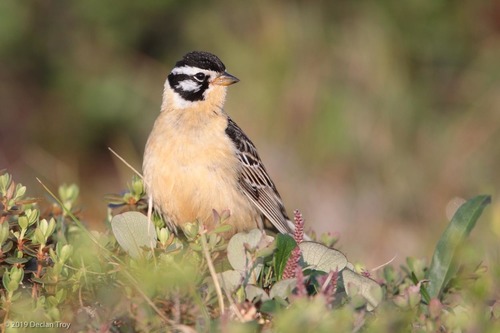
Smith's Longspur
Calcarius pictus
The Smith's Longspur is a golden-bellied gem of the American grasslands. This secretive traveler migrates from the Arctic tundra to southern prairies, living a life almost entirely on the wing or hidden deep within the short grass.
Quick Identification
Size
Length: 5.9-6.7 in (15-17 cm); Wingspan: 10.2-11.4 in (26-29 cm); Weight: 0.8-1.1 oz (22-32 g)
Colors
Breeding males feature a striking deep ochre or orange-buff belly and breast, with a bold black-and-white striped face. Females and non-breeding males are more sparrow-like with streaky brown backs, but maintain a warm buffy wash on the underparts and show white outer tail feathers.
Key Features
- Rich ochre-orange underparts on breeding males
- White outer tail feathers prominent during flight
- Bold black-and-white triangular face pattern
- Elongated hind claw (the 'longspur')
- Small white patch on the lesser coverts of the wing
When You’ll See Them
Behavior
Smith's Longspurs are the elusive ghosts of the open grasslands. Unlike many songbirds that announce their presence from high perches, these birds are dedicated ground-dwellers. They spend their days walking or running through short grass, staying remarkably well-concealed until they are nearly stepped on. When flushed, they take to the air in an erratic, undulating flight while emitting a dry, clicking rattle call that is often the first clue to their presence.
During the winter, they are highly social and congregate in flocks, often mixing with other grassland species like Horned Larks or Lapland Longspurs. They exhibit a fascinating social structure during the breeding season known as polygynandry, where groups of several males and several females mate somewhat indiscriminately within their small circle—a rare behavior in the bird world that reduces territorial aggression in the vast, open tundra.
EverydayEarth exclusive
Camera Tips
Capturing a Smith's Longspur on a trail camera requires a specialized 'ground-up' approach. Because these birds rarely, if ever, land on branches or tall structures, you must position your camera at a very low height—no more than 4 to 6 inches off the ground. Aim the lens horizontally across a flat, open patch of short-mown grass or a recently grazed pasture. Using a wide-angle lens is ideal, as it captures more of the ground where these birds spend 95% of their time.
To lure these secretive birds into your camera's frame, create a 'feeding zone' by scattering finely cracked corn, white proso millet, or sunflower hearts directly onto the bare earth or very short grass. Avoid using traditional raised bird feeders, as longspurs are naturally hesitant to leave the safety of the ground. A shallow, ground-level water feature, such as a heated birdbath or a simple saucer of water placed in an open field, can be a magnet for them during dry winter spells when natural water sources are frozen.
Timing and settings are crucial for this species. Set your camera to a 'burst mode' or high-speed photo capture because longspurs are incredibly fast and twitchy. They are most active in the first few hours after sunrise when the light is golden but low. If your camera allows for ISO adjustments, set it slightly higher to ensure a fast shutter speed, which prevents motion blur as they scurry through the grass. If you are in their winter range, look for large open spaces like regional airports or fallow farm fields to set up your gear, as they prefer these 'wide open' vistas over enclosed suburban yards.
Similar Species
Species that look similar or are commonly confused with Smith's Longspur.
Lapland Longspur
Lapland Longspurs have white bellies and more streaking on their flanks compared to the buff/orange belly of the Smith's.
Horned Lark
Horned Larks have a distinct yellow throat and black 'horns' or head stripes, lacking the overall buffy tones of the longspur.
Savannah Sparrow
Savannah Sparrows have a distinct yellow patch near the eye and lack the white outer tail feathers and rich buff underparts.
Frequently Asked Questions
Record Smith's Longspur at your habitat
Connect a camera to start building your own species record — AI identifies every visitor automatically.