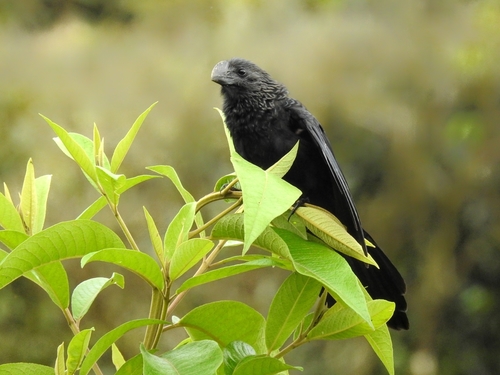
Smooth-billed Ani
Crotophaga ani
With their oversized bills and deep-black plumage, Smooth-billed Anis are the charismatic 'socialites' of the bird world. Usually found in bustling family groups, these fascinating cuckoos bring a touch of the tropics to any backyard camera setup.
Quick Identification
Size
Length: 30–36 cm (12–14 in); Wingspan: 43–45 cm (17–18 in); Weight: 70–120 g (2.5–4.2 oz)
Colors
Uniformly coal-black with a faint bronze or violet iridescence on the neck and wings; bill and legs are charcoal gray to black.
Key Features
- Massive, high-arched bill with a smooth ridge
- Long, floppy tail that appears loosely attached
- Social groups of 5-15 birds foraging together
- Distinctive whistling 'ah-nee' call
When You’ll See Them
Behavior
Perhaps their most unique trait is their 'group-living' approach to parenthood. Multiple females in a group will lay their eggs in one large, shared nest built of sticks. The entire community, including males and non-breeding helpers, takes turns incubating the eggs and feeding the hungry chicks. They are vocal birds, constantly communicating with a variety of whistles and liquid chirps to keep the group coordinated while moving through dense brush.
EverydayEarth exclusive
Camera Tips
While they won't visit a standard bird feeder for seeds, they are highly attracted to water. A wide, shallow ground-level birdbath is the ultimate lure for a group of Anis. Because they move in packs, a single birdbath can often result in a 'party' on camera with four or five birds drinking and bathing at once. Position your camera about 5-8 feet from the water source and use a wide-angle setting to ensure you don't miss the social interactions happening at the edges of the frame.
For camera settings, prioritize a fast trigger speed and use 'Burst Mode' or high-definition video. Anis have very expressive movements—their long tails flop around and they often engage in 'allopreening' (grooming each other). Video is particularly effective because it captures their unique whistling calls, which are a major part of their charm. If your camera allows for sensitivity adjustments, set it to 'High' to ensure it triggers even when the birds are moving through tall grass at the edge of the frame.
Lighting is the biggest challenge when photographing jet-black birds. To avoid the 'black blob' effect, place your camera with the sun at its back. The morning sun (between 8 and 10 AM) is ideal, as it will catch the subtle, metallic iridescence on their feathers, revealing textures that are invisible in flat or harsh midday light. If you are in a tropical or humid environment, check your lens for morning fogging; a small rain hood or a desiccant pack inside the camera housing can keep your shots crisp during the humid hours when these birds are most active.
Similar Species
Species that look similar or are commonly confused with Smooth-billed Ani.
Frequently Asked Questions
Record Smooth-billed Ani at your habitat
Connect a camera to start building your own species record — AI identifies every visitor automatically.