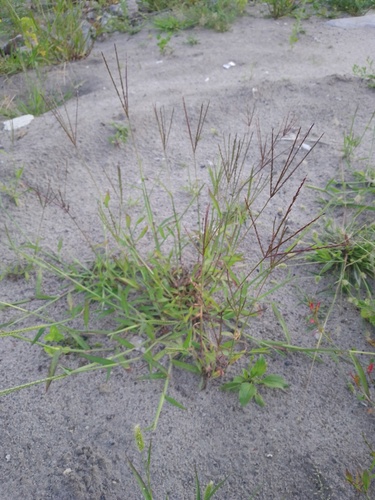
smooth crabgrass
Digitaria ischaemum
A resilient specialist of the sunny lawn, smooth crabgrass is a master of low-profile survival. Easily identified by its hairless stems and vibrant late-summer purple hues, it is a fascinating example of botanical adaptation in our own backyards.
Quick Identification
Size
Height ranges from 5 to 15 inches (12 to 38 cm); sprawling mats can spread 6 to 12 inches (15 to 30 cm) wide.
Colors
Dull green to light green foliage; stems often transition to a distinctive reddish-purple or burgundy at the base.
Key Features
- Smooth, hairless leaf blades and sheaths
- Sprawling 'starburst' growth habit
- Inflorescence with 2-6 finger-like branches
- Stems that do not root at the nodes
- Small, oval spikelets lined in rows
When You’ll See Them
Behavior
Smooth crabgrass is a highly adaptable annual grass that thrives in the sunny, often compacted soils of suburban backyards. It typically germinates in late spring when soil temperatures reach a consistent 55 degrees Fahrenheit. Unlike many upright grasses, it grows in a prostrate, outward-spreading pattern that allows it to stay below the height of most lawnmower blades, ensuring its survival in well-maintained gardens.
As the plant matures toward late summer, it shifts its energy from leaf production to reproduction, sending up slender, finger-like seed heads. While it is often considered a nuisance in manicured turf, smooth crabgrass plays a role in the local ecosystem by stabilizing disturbed soil and providing a late-season seed source for small ground-foraging birds. It is a true sun-seeker, often outcompeting other grasses in areas with high heat and limited shade.
EverydayEarth exclusive
Camera Tips
Capturing high-quality images of smooth crabgrass requires a different strategy than tracking moving animals. Since this plant is low to the ground, you should position your AI-powered camera on a mini-tripod or a ground mount, keeping the lens just 3 to 6 inches above the turf. This low angle allows you to capture the 'starburst' pattern of the stems and the unique purple coloring at the base of the plant, which are its most identifying features.
To get the best results with an AI camera, use a time-lapse setting rather than a motion trigger. Smooth crabgrass doesn't move much on its own, but a time-lapse over 24 hours can beautifully illustrate how the leaves slightly curl to conserve water during the heat of the day and relax in the evening. If you are using an AI identification system, ensure there is high contrast between the crabgrass and the background by clearing away any dead brown thatch or taller weeds that might confuse the sensor.
Lighting is the most critical factor for a clear profile. The best 'hero shots' are captured during the golden hour—shortly after sunrise or before sunset. The low-angled light catches the smooth texture of the leaves, helping to distinguish it from the hairy leaves of its cousin, the large crabgrass. If your camera has a macro mode, use it to get close-ups of the finger-like seed heads in late August, as these are the primary diagnostic tool for the species. Watch for morning dew on the lens, as ground-level placement makes the camera more susceptible to moisture fogging.
Frequently Asked Questions
Record smooth crabgrass at your habitat
Connect a camera to start building your own species record — AI identifies every visitor automatically.