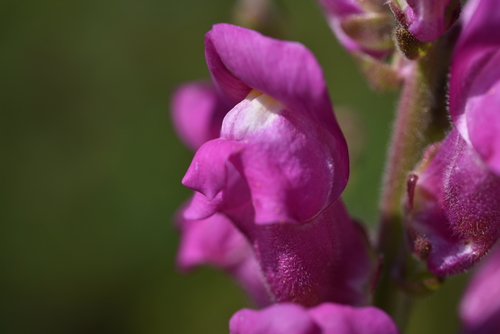
Snapdragon
Antirrhinum majus
Famous for flowers that 'snap' open like a dragon's mouth, these garden favorites are more than just a pretty face—they are a high-tech landing pad for the world's most industrious bumblebees.
Quick Identification
Size
Height ranges from 15–120 cm (6–48 inches) depending on variety; spread of 15–30 cm (6–12 inches).
Colors
Vibrant hues including red, yellow, pink, white, purple, orange, and many bicolors; foliage is typically a deep, lance-shaped green.
Key Features
- Distinctive 'dragon' flower shape that 'snaps' open when sides are squeezed
- Tall, vertical flowering spikes (racemes)
- Opposite or spirally arranged lanceolate leaves
- Unique bilateral symmetry designed for heavy pollinators
When You’ll See Them
Behavior
The common snapdragon is a fascinating study in botanical engineering. Unlike many flowers that provide easy access to nectar, the snapdragon’s petals are tightly closed, requiring a specific amount of force to open. This creates a specialized relationship with heavy-bodied pollinators, particularly bumblebees, who are strong enough to push through the 'lips' of the flower to reach the reward inside. This mechanism ensures that the plant's pollen is efficiently transferred by specific, high-value insects rather than being wasted on smaller flies or ants.
As a garden staple, they exhibit 'upward' blooming behavior, where the flowers at the bottom of the stalk open first, followed progressively by those higher up. This staggered blooming period makes them a long-lasting resource for backyard wildlife. While humans see them as ornamental, they are highly responsive to light and temperature, often thriving in the cooler parts of the growing season and entering a semi-dormant state during extreme summer heat.
EverydayEarth exclusive
Camera Tips
To capture the best footage of snapdragons, position your camera on a low-profile tripod or a ground stake. Since snapdragons vary in height, set the lens at the midpoint of the flower spike (about 12-18 inches high for standard varieties) to capture both the blooming structure and the arrival of pollinators. A slight upward angle can make the flower spikes look more majestic against the sky or garden backdrop.
The real magic of snapdragons on camera happens through time-lapse photography. Set your camera to take a photo every 15-30 minutes over several days. This will allow you to see the 'climbing' bloom pattern as the flowers open from the bottom of the stalk to the top. Ensure your camera is in a spot that receives consistent light but is protected from high winds, which can cause motion-blur in your time-lapse sequence.
If you are looking to capture wildlife interaction, snapdragons are bumblebee magnets. Set your camera to 'High-Speed Video' or 'Burst Mode' with a fast shutter speed. This is essential for freezing the motion of a bumblebee as it forces its way into the flower's 'mouth.' Because these interactions happen quickly, a PIR (passive infrared) sensor might not always trigger fast enough; consider using a camera with a 'Pre-roll' feature or manual video recording during peak sunny hours when bees are most active.
Lighting is crucial for showing off the velvety texture of the petals. Early morning 'golden hour' light provides a soft glow that highlights the intricate veins and color gradients of the blooms. Avoid mid-day sun if possible, as it can wash out the saturated reds and purples. If your camera allows for macro settings, get as close as 6-10 inches to capture the fine hairs and structures that guide insects into the nectar chamber.
Similar Species
Species that look similar or are commonly confused with Snapdragon.
Frequently Asked Questions
Record Snapdragon at your habitat
Connect a camera to start building your own species record — AI identifies every visitor automatically.