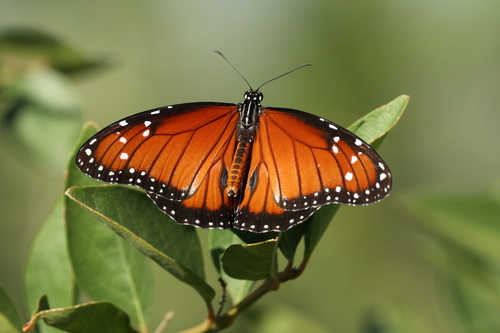
Soldier
Danaus eresimus
With its rich mahogany wings and delicate white-spotted borders, the Soldier is a regal visitor to tropical and subtropical gardens. Often mistaken for the Queen or Monarch, this resilient butterfly is a master of the warm southern breeze.
Quick Identification
Size
Wingspan of 2.5 to 3.5 inches (6.4 to 8.9 cm)
Colors
Deep mahogany or burnt orange wings with black borders; two rows of small white spots on wing edges; faint, ghostly white patches on the underside of the hindwings
Key Features
- Deep brownish-orange color darker than a Monarch
- Black wing margins with white spots
- Faint white 'ghost' spots on the center of the hindwing underside
- Thin black wing veins that lack heavy shading
When You’ll See Them
Geographic range
Where Does the Soldier Live?
The Soldier butterfly is a vibrant resident of the Americas, with a native range stretching from the southern United States through the Caribbean and Central America, reaching as far south as Argentina. Within the U.S., it is most commonly established in the tropical environments of southern Florida and the Rio Grande Valley in Texas. While they are primarily residents of warmer climates, they are known to occasionally stray northward into the Great Plains and Gulf Coast states during the warmer summer months.
Basemap © OpenStreetMap contributors
Behavior
The Soldier is a graceful flyer often seen patrolling sunny, open areas with a characteristic flap-and-glide motion. Unlike its more famous relative, the Monarch, the Soldier tends to stay lower to the ground, weaving through tall grasses and shrubs in search of nectar. It is a somewhat wary butterfly, quickly taking flight if it senses a large shadow or sudden movement, but it can become remarkably focused when feeding on high-quality nectar sources.
These butterflies are largely solitary but will congregate in significant numbers where nectar is abundant or at 'puddling' sites. Males are known for their territorial behavior, frequently perching on prominent leaves to watch for passing females or to chase away rival males. They rely on chemical signaling, using specialized scent scales on their wings to attract mates during their elaborate courtship flights.
EverydayEarth exclusive
Camera Tips
To successfully capture the Soldier on your backyard AI camera, focus on 'bottleneck' nectar sources. These butterflies are highly attracted to white and purple blooms, particularly Spanish Needles (Bidens alba) and Blue Mistflower. Position your camera on a tripod or mount at a height of 2 to 3 feet, aiming at a cluster of flowers that receives full sun for at least six hours a day. Because Soldiers are relatively small, a macro lens or a camera with a close focal distance (12-18 inches) will provide the best detail of their intricate wing patterns.
Lighting is the most critical factor for this species; their deep mahogany wings can appear almost black in deep shade, so ensure your camera is positioned with the sun at its back to illuminate the butterfly's upper wing surfaces. If your camera allows for manual shutter speed adjustments, use a high speed (1/1000s or faster) to freeze the motion of their wings during flight. For a unique behavioral shot, place a 'puddling station'—a shallow dish filled with damp sand and a pinch of sea salt—near your flower beds. Soldiers will often land here to drink mineral-rich water, providing a perfect opportunity for eye-level, stationary portraits.
Lastly, consider the host plant strategy. Planting Climbing Milkvine (Funastrum clausum) or Giant Milkweed will attract females looking to lay eggs. By placing your camera near the tender new growth of these plants, you increase your chances of capturing egg-laying behavior or the strikingly striped caterpillars. Set your motion sensitivity to 'High' to ensure the camera triggers even for the light, fluttering movements of a butterfly entering the frame.
Frequently Asked Questions
Record Soldier at your habitat
Connect a camera to start building your own species record — AI identifies every visitor automatically.