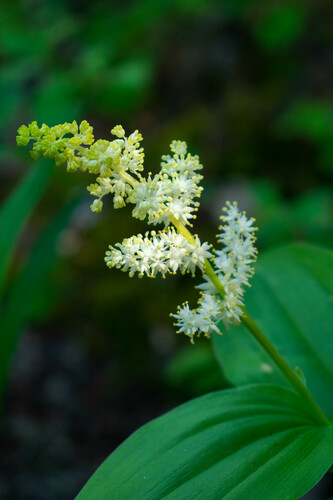
Solomon's plume
Maianthemum racemosum
An elegant woodland resident with arching stems and feathery white blooms, Solomon's plume transforms into a ruby-red banquet for backyard birds by late summer.
Quick Identification
Size
Stems typically reach 30–90 cm (1–3 ft) in height; leaves measure 7–15 cm (3–6 in) long
Colors
Bright green leaves; creamy white to yellowish-white flowers; berries transition from green-speckled to ruby red
Key Features
- Arching, unbranched zig-zag stem
- Flower cluster (panicle) located at the very tip of the stem
- Alternate, lance-shaped leaves with prominent parallel veins
- Translucent red berries in late summer
When You’ll See Them
Behavior
Solomon's plume, also known as false spikenard, is a perennial woodland wildflower that plays a vital role in the backyard ecosystem. It emerges in early spring with an elegant, arching habit, leaning toward patches of sunlight filtering through the forest canopy. While it remains stationary, its biological 'behavior' is timed perfectly with local fauna; it blooms in late spring to provide nectar for small bees and flies, then spends the summer developing nutrient-rich fruits.
By late summer and autumn, the plant's berries (sometimes called treacleberries) become a high-energy food source for migrating birds and small mammals preparing for winter. Unlike many other woodland plants, Solomon's plume is quite hardy and can form large colonies over time through its creeping rhizomes, making it a reliable fixture for local wildlife and a consistent subject for backyard observers.
EverydayEarth exclusive
Camera Tips
To capture the best action around your Solomon's plume, position your camera at a low-angle 'worm’s-eye view,' roughly 12 to 18 inches off the ground. This perspective allows you to see the underside of the arching stem and perfectly frames the terminal flower plume where pollinators frequent. Since this plant doesn't move, your camera's AI will primarily be triggered by the visitors it attracts; setting a high sensitivity for small motion is key to catching the sweat bees and hoverflies that visit the white blossoms.
During the late summer berry phase, shift your camera's focus toward the tip of the stem. This is when the plant becomes a magnet for birds like Thrashers, Catbirds, and Robins. Because these berries are often tucked under the foliage or at the very end of a swaying stalk, use a faster shutter speed if your camera allows it to avoid motion blur from wind or bird activity. Placing the camera 3-5 feet away from the plant ensures you capture the 'landing' behavior of birds as they snatch the red fruits.
For a truly unique project, use a time-lapse setting during the month of May. Set your camera to take one photo every hour during daylight. This will showcase the 'circumnutation' or the subtle dancing movement of the stem as it grows and follows the sun, as well as the dramatic unfolding of the feathery flower head. Ensure your camera is mounted on a sturdy stake to prevent shifting over the weeks of recording.
If you are using an AI-powered camera like those from EverydayEarth, Solomon's plume serves as an excellent 'natural stage.' Instead of a bird feeder, use the plant as the central point of interest. The contrast of the ruby-red berries against the green leaves provides excellent color triggers for AI detection. Ensure the area behind the plant is relatively clear to prevent 'false triggers' from background branches, allowing the camera to focus exclusively on the wildlife interacting with the plume.
Frequently Asked Questions
Record Solomon's plume at your habitat
Connect a camera to start building your own species record — AI identifies every visitor automatically.