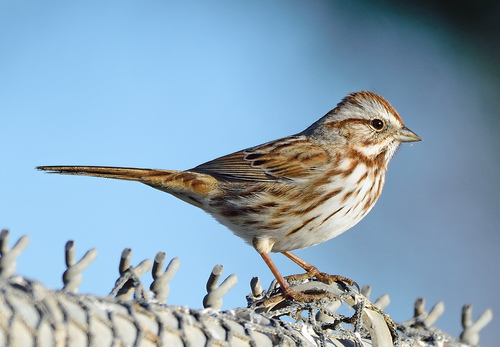
Song Sparrow
Melospiza melodia
The Song Sparrow is a master of melody and a staple of the American backyard. Easily recognized by its soulful song and distinctive streaked chest, this adaptable bird brings life and music to every garden.
Quick Identification
Size
Length: 4.7–6.7 in (12–17 cm); Wingspan: 7.1–9.4 in (18–24 cm); Weight: 0.4–1.9 oz (12–53 g)
Colors
Heavily streaked with warm browns and grays; white or grayish underparts with thick brown streaks that typically converge into a large central spot on the breast.
Key Features
- Prominent dark 'stick-pin' spot in the center of a streaked breast
- Long, rounded tail that it frequently pumps downward during flight
- Broad grayish eyebrow stripe contrasting with a reddish-brown crown
When You’ll See Them
Sightings on EverydayEarth
Apr 21, 2026
A Song Sparrow flies into the scene and lands on the lower perch of the seed feeder. It pauses to look around the yard before beginning to investigate the feeder ports.
Apr 23, 2026
A Song Sparrow is actively foraging on the main tray, sifting through the sunflower seeds and pecking. In the background, a Pine Siskin is perched on the Nyjer seed feeder.
Jul 29, 2026
A busy scene at the feeders in Sapsucker Woods. A Mourning Dove sits calmly on the main tray while a Downy Woodpecker feeds on suet. Several Red-winged Blackbirds are active, with one showing its bright red shoulder patches on the right tube feeder, and another landing on the left side of the tray late in the clip. A Song Sparrow is also busy at a smaller mesh feeder.
Jul 27, 2026
A vibrant morning at the feeders featuring a male Northern Cardinal feeding on the tray. A European Starling and a Downy Woodpecker share the suet feeder in the background. A Song Sparrow briefly joins the cardinal on the tray before the cardinal flies off, followed shortly by the other birds shifting positions.
Jul 20, 2026
A Common Grackle lands on top of the tube feeder on the right, looking around while its iridescent plumage catches the light. Meanwhile, a Song Sparrow hops onto the central tray feeder and begins foraging among the seeds. A second grackle is briefly seen landing on the central wooden feeder post before flying away.
Jul 20, 2026
A European Starling with prominent pale speckling on its dark feathers perches on the feeder tray, looking around before exploring the base of the support pole. Above it, a Song Sparrow is busy at the suet feeder, its streaked plumage visible as it feeds.
Behavior
In the air, you can identify them by their distinctive flight style—they usually stay low to the ground, moving with a jerky, undulating motion while constantly pumping their rounded tails up and down. While they are fierce defenders of their small territories during the breeding season, they often join mixed flocks of other sparrows and juncos during the winter months, making them a staple of the backyard birding experience.
EverydayEarth exclusive
Camera Tips
To capture high-quality footage of a Song Sparrow, placement is everything. These birds are ground-dwellers by nature, so your camera should be positioned low—ideally between 6 and 18 inches off the ground. Aim the lens toward an area of 'managed messiness,' such as a patch of leaf litter or the base of a dense hedge. Because they are shy about open spaces, placing your camera right at the interface where a garden bed meets a lawn will yield the most natural behavior. If you are using a trail camera, a focal distance of 3–5 feet is ideal to capture the fine details of their streaked plumage.
Song Sparrows are highly attracted to water, especially shallow, moving water. Setting up your AI camera near a ground-level birdbath or a small trickling fountain is a guaranteed way to get clear, front-facing shots. They are also enthusiastic visitors to ground-feeding stations. Instead of using a hanging feeder, scatter a mix of white proso millet, cracked corn, and hulled sunflower seeds directly on the ground or on a low platform feeder. This mimics their natural foraging strategy and will keep them in the camera's frame for longer durations as they scratch for seeds.
From a technical standpoint, Song Sparrows are incredibly fast and 'twitchy' birds. To avoid motion blur, use a camera with a fast trigger speed (0.2 seconds or less) and set your video to a high frame rate (at least 60fps) if possible. Since they are most active during the early morning 'dawn chorus,' ensure your camera is positioned to take advantage of the morning light without being blinded by the direct sun. If your camera supports sound-triggered recording, this is the perfect species for it—their loud, distinctive songs (starting with two or three clear notes followed by a trill) are often the first sign they are nearby, even before they hop into the visual frame.
Finally, consider the seasonal changes in their behavior. In the spring, look for the tallest branch or fence post in your yard; this is where the male will sing. Mounting a camera at eye-level facing one of these known 'song posts' can result in stunning, clear portraits. In the winter, they will be much more focused on ground-feeding in groups, so shifting your camera focus to the sheltered side of a brush pile or thicket will capture the social dynamics of the winter flock.
Similar Species
Species that look similar or are commonly confused with Song Sparrow.
Lincoln's Sparrow
Look for finer, thinner streaks and a distinctive buff-colored (creamy tan) wash across the chest and face.
Savannah Sparrow
Distinguishable by a small but bright yellow patch on the face right in front of the eye (the lores) and a shorter tail.
Fox Sparrow
Much larger and chunkier, with heavy 'chevron' shaped spotting on the breast and often more vibrant reddish-brown tones.
Frequently Asked Questions
Record Song Sparrow at your habitat
Connect a camera to start building your own species record — AI identifies every visitor automatically.