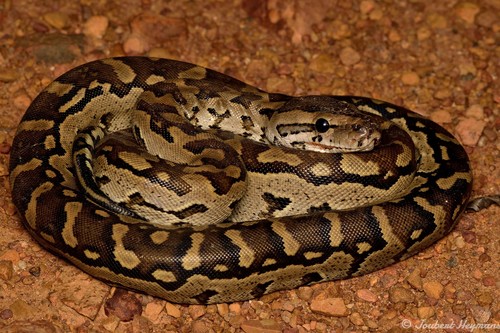
Southern African Python
Python natalensis
Meet Africa's largest snake, the Southern African Python, a master of camouflage and a powerful guardian of the savanna ecosystem. From rocky hillsides to suburban garden edges, this magnificent constrictor is a thrilling find for any backyard explorer.
Quick Identification
Size
Typically 3 to 4.5 metres (10 to 15 feet), with rare individuals exceeding 5.5 metres (18 feet); weight ranges from 30 to 60 kg (66 to 132 lbs).
Colors
Intricate patterns of dark brown, olive, and grey blotches on a tan background; distinctive dark 'spearhead' mark on the head; cream or white belly with dark speckles.
Key Features
- Large, triangular head with a dark spearhead marking
- Heat-sensing pits on the scales of the upper lip
- Subocular scales that separate the eye from the lip scales
- Massive, muscular girth with smooth, non-keeled scales
When You’ll See Them
Geographic range
Where Does the Southern African Python Live?
This massive serpent is native to the southern half of the African continent. Its core range extends across South Africa, Zimbabwe, Namibia, Botswana, and Mozambique, reaching northward into southern Angola and Zambia. In these regions, it is a staple of the savanna landscape, though it is increasingly finding refuge in protected conservancies and larger suburban estates that border natural wilderness.
Basemap © OpenStreetMap contributors
Behavior
The Southern African Python is a formidable ambush predator, spending much of its time coiled in thick vegetation or submerged in water waiting for prey. While they are non-venomous, they possess incredible strength, using a 'strike and constrict' method to subdue animals. They are generally solitary and can be surprisingly shy, preferring to retreat into deep burrows, rock crevices, or water when disturbed. However, they are known to be defensive and will hiss loudly or strike if they feel cornered.
These snakes are highly dependent on water and are excellent swimmers, often remaining submerged for extended periods with only their nostrils exposed. In suburban areas bordering natural bush, they may occasionally venture into gardens in search of water or prey. During the cooler winter months, they become less active and often 'den' in underground burrows, sometimes sharing space with other animals like aardvarks or porcupines to maintain a stable body temperature.
EverydayEarth exclusive
Camera Tips
Capturing a Southern African Python on camera requires a bit of strategy since they don't produce a strong heat signature like mammals. Set your camera to its highest PIR (Passive Infrared) sensitivity or, better yet, use a 'Time Lapse' mode with short intervals (every 1-5 minutes) if you suspect a python is frequenting an area. Place the camera low to the ground, about 30-50cm (12-20 inches) high, angled slightly downward to cover the ground or a known game trail.
Focus your efforts near water sources or 'basking spots'—flat rocks or open patches of sand that catch the morning sun. Pythons are most likely to move during the transition between day and night, so ensure your camera has high-quality infrared LEDs for clear nighttime footage. Since they are ambush predators, they may stay in one spot for days; if you see a large, coiled shape on your footage that doesn't move for 48 hours, it is likely just a python digesting a meal.
While you cannot easily 'bait' a python with food (they only eat live or very fresh prey), you can attract them indirectly by creating a habitat for their prey. A brush pile or a well-maintained bird feeder will attract rodents and birds, which in turn acts as a natural lure for the python. Always ensure the camera is secured to a sturdy post or tree, as these snakes are heavy enough to knock over lightweight tripods if they crawl over them.
Frequently Asked Questions
Record Southern African Python at your habitat
Connect a camera to start building your own species record — AI identifies every visitor automatically.