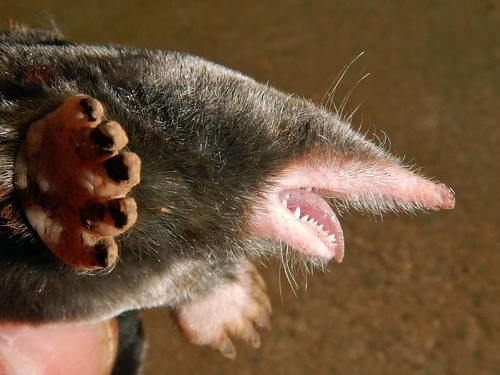
Southern Broad-footed Mole
Scapanus occultus
A secretive subterranean specialist, the Southern Broad-footed Mole is Southern California's most industrious excavator. With powerful spade-like paws and velvet fur, this tiny powerhouse creates complex underground worlds right beneath our feet.
Quick Identification
Size
5.1 to 6.7 inches (130-170 mm) in length; weight between 1.8 and 3.2 ounces (50-90 g).
Colors
Uniformly silver-black to dark chocolate brown with velvety fur; slightly paler underparts and a flesh-colored snout.
Key Features
- Massive spade-like front paws with outward-facing claws
- Tiny eyes covered by thin skin and no external ear flaps
- Short, sparsely haired tail
- Dense, velvety fur that can be brushed in any direction
When You’ll See Them
Behavior
The Southern Broad-footed Mole is a master of the subterranean world, spending nearly its entire life in an intricate network of tunnels. Unlike many other small mammals, they are highly solitary and territorial, vigorously defending their tunnel systems from any intruders. They are known for their incredible strength-to-size ratio, using their specialized "broad" feet to literally swim through the soil, pushing excess dirt to the surface to create the characteristic volcano-shaped mounds many homeowners recognize.
While they are often viewed as pests by gardeners, these moles provide valuable ecosystem services by aerating the soil and consuming large quantities of lawn-damaging larvae. They have high metabolic rates and must eat frequently, alternating between periods of intense digging and resting within their deeper nesting chambers. Humans rarely see them above ground unless a tunnel is flooded or a juvenile is dispersing to find its own territory in the late spring.
EverydayEarth exclusive
Camera Tips
Capturing a Southern Broad-footed Mole on camera is a badge of honor for any backyard naturalist because they so rarely emerge from their tunnels. The most successful strategy is "mound monitoring." When you see a fresh mound of moist soil appear, use a small trowel to carefully clear a portion of the tunnel opening. Position your camera on a low-profile stake just 4-6 inches off the ground, angled directly at the opening. Moles are incredibly sensitive to light and air currents; if they feel a draft, they often return within minutes to plug the hole, which is your best chance to catch them in the act on video.
Since these moles are most active at night, ensure your camera has a high-quality infrared flash that won't "blow out" the image at close range. Set your camera to video mode with the shortest possible trigger delay. If your camera allows for macro-focusing or close-up shots, use those settings, as the mole will likely be just inches from the lens. Because they are sensitive to vibrations, avoid walking near the camera site once it's set up; check your footage only once every 24 hours to minimize disturbance.
Another advanced tip involves targeting "surface runs"—those raised ridges of sod often seen after heavy rain. These are temporary foraging tunnels. If you find a very active run, you can place a clear plastic sheet or a glass "viewing box" over a small breached section of the surface and position the camera to look through the clear material. This can sometimes capture the mole as it passes through the shallow tunnel. Avoid using artificial baits, as these moles are motivated by the movement of live prey like worms, which are difficult to simulate for a camera trap.
Similar Species
Species that look similar or are commonly confused with Southern Broad-footed Mole.
Frequently Asked Questions
Record Southern Broad-footed Mole at your habitat
Connect a camera to start building your own species record — AI identifies every visitor automatically.