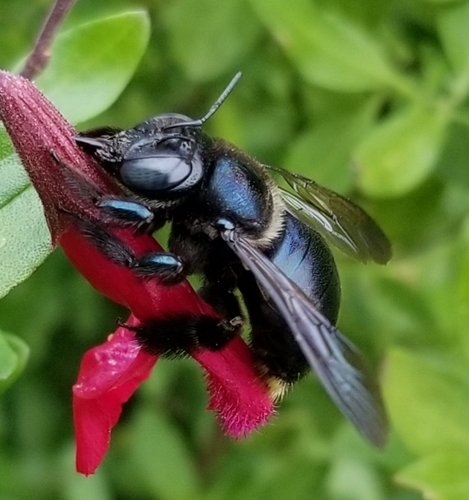
Southern Carpenter Bee
Xylocopa micans
With its shimmering violet-blue armor and gentle nature, the Southern Carpenter Bee is a crown jewel of the southeastern garden. A master of buzz-pollination, this solitary giant is a vital pollinator that brings life and color to coastal landscapes.
Quick Identification
Size
15-20 mm (0.6-0.8 inches) in length; wingspan of approximately 35-40 mm (1.4-1.6 inches)
Colors
Brilliant metallic dark blue, violet, or green-black; females are entirely dark and shimmering, while males have light yellowish hairs on the thorax and a white 'mustache' on the face.
Key Features
- Shiny, metallic abdomen without dense hair
- Large, robust 'bumblebee' shape
- Metallic blue or purple luster in sunlight
- Males have distinct white or yellow facial markings
When You’ll See Them
Behavior
The Southern Carpenter Bee is a fascinating solitary insect that lacks the social colony structure of honeybees. Instead of a hive, each female is her own queen, painstakingly excavating a nest tunnel in pithy wood or dead branches. You’ll often see them performing 'buzz pollination,' where they vibrate their flight muscles at a specific frequency to dislodge stubborn pollen from flowers that other bees can't reach. They are also known as 'nectar robbers,' sometimes bypassing the flower’s opening to pierce the base of the bloom and steal nectar without providing pollination services.
Despite their large size and loud, intimidating buzz, Southern Carpenter Bees are remarkably docile. Males are territorial and may 'investigate' you by hovering closely, but they lack a stinger and are completely harmless. Females have a stinger but will only use it if handled roughly or stepped on. Unlike their cousins, the Eastern Carpenter Bee, this species rarely bores into the structural timbers of homes, preferring natural woody debris and coastal shrubbery, making them a welcome, non-destructive guest in the garden.
EverydayEarth exclusive
Camera Tips
To capture the stunning metallic sheen of the Southern Carpenter Bee, lighting is everything. Place your AI-powered camera in a spot that receives full, direct sunlight between mid-morning and late afternoon. When the sun hits their exoskeleton at the right angle, it reflects brilliant purples and blues that are often lost in the shade. Position your camera about 12 to 24 inches away from 'honey-pot' plants like Salvia, Passionflower, or Lavender. Because these bees are fast flyers, using a camera with a high frame rate or a 'pro-capture' mode that buffers frames will help you catch that perfect mid-air hover.
If you want to film their unique nesting behavior, look for upright, dead stalks of plants or soft-wood branches. Look for perfectly circular holes about the diameter of a finger. Mount your camera on a tripod at the same height as the entrance, angled slightly to look into the tunnel. Avoid placing the camera too close to the hole's entrance as it might shade the opening, which can discourage the bee from entering or exiting while you're filming. A side-profile view is usually best for capturing the bee as it lands and shimmy-shakes its way inside.
Seasonal timing is crucial for capturing mating behavior. In early spring, males will stake out territories near flowering bushes and hover persistently. If your camera is set to trigger on motion, this is the best time to get clear shots of the males' distinctive white facial markings. During the heat of mid-summer, focus your camera on water sources or birdbaths with landing stones; like many insects, these bees will visit shallow water to drink and cool down during the peak of the day.
Similar Species
Species that look similar or are commonly confused with Southern Carpenter Bee.
Frequently Asked Questions
Record Southern Carpenter Bee at your habitat
Connect a camera to start building your own species record — AI identifies every visitor automatically.