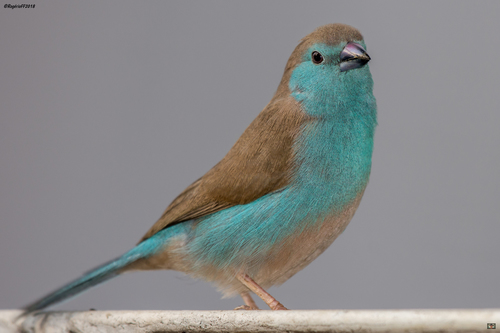
Southern Cordonbleu
Uraeginthus angolensis
The Southern Cordonbleu is a vibrant splash of sky-blue among the golden grasses of Africa. A frequent visitor to backyard feeders and bird baths, this social little finch is a favorite for photographers and nature lovers alike.
Quick Identification
Size
Length: 11-13 cm (4.3-5.1 in); Wingspan: 15-18 cm (5.9-7.1 in); Weight: 8-12 g (0.28-0.42 oz)
Colors
Sky-blue face, breast, flanks, and tail; soft brownish-grey crown, neck, and wings. Males exhibit more vibrant blue; females are paler with less blue on the face.
Key Features
- Brilliant sky-blue underparts and tail
- Plain brownish-grey upperparts and crown
- Short, pointed bill with a pinkish or purplish base
- Frequent tail-flicking movement
When You’ll See Them
Sightings on EverydayEarth
Jul 9, 2026
A small flock of Southern Cordonbleus is seen flitting through the branches of a thorny bush. The birds are actively hopping between perches and looking around their environment.
May 31, 2026
Several small birds, including Blue-breasted Cordon-bleus, are seen hopping along the muddy edge of a watering hole. They appear to be foraging for seeds or insects in the damp soil and short grass.
Geographic range
Where Does the Southern Cordonbleu Live?
The Southern Cordonbleu is a signature species of the Southern African subregion, where it remains a widespread and common resident. Its native range extends from the northern provinces of South Africa and Namibia, through the vast savannas of Botswana and Zimbabwe, into Mozambique, Zambia, and southern Angola. While primarily found in these southern latitudes, their presence also reaches into parts of East Africa, including Malawi and Tanzania, where they thrive in semi-arid and subtropical environments.
Basemap © OpenStreetMap contributors
Behavior
The Southern Cordonbleu is a highly social and endearing finch, often found in pairs or small family groups. They are frequently seen foraging on the ground, hopping with a characteristic light, bouncy movement as they search for tiny seeds. They are well-known for their 'chinking' calls and a soft, warbling song that adds a gentle soundtrack to the African bushveld and suburban gardens alike.
These birds are remarkably bold around humans, often becoming quite tame in garden settings where food and water are provided. They frequently participate in mixed-species foraging flocks, often associating with other waxbills, firefinches, and twinspots. During courtship, the male performs a charming dance, holding a blade of grass in his beak and bouncing rhythmically on a branch while singing to the female.
EverydayEarth exclusive
Camera Tips
To capture the stunning blue plumage of the Southern Cordonbleu, place your camera very low to the ground—ideally no more than 12 inches high. These birds spend the majority of their active time foraging on the earth, so a camera positioned at their eye level will create a much more intimate and professional-looking portrait. Ground-level water features or shallow bird baths are absolute magnets for these birds, especially in the drier winter months.
If you are using bait to draw them in, small-grain birdseed or millet (often sold as 'manna') is the most effective choice. Avoid large seeds or suet, as their small beaks are designed for tiny grass seeds. Scatter the seed in a patch of filtered sunlight; the indirect light will help the camera sensor capture the iridescence of their blue feathers without the harsh glare or 'blown-out' highlights that occur in direct African midday sun.
Because Cordonbleus are fast-moving and prone to sudden flights, set your AI camera to its highest trigger speed. If your device supports it, use a 'Burst Mode' to capture a series of 3 to 5 images per trigger. This increases your chances of getting a clear shot of their tail-flicking behavior or a sharp image while they are in motion. Video mode at 60fps is also an excellent way to capture their delicate social interactions and songs.
Lastly, ensure there is a thicket or a 'jumping-off' branch within two or three feet of your camera setup. Southern Cordonbleus are cautious and prefer to survey an area from the safety of a bush before descending to the ground. A well-placed branch in the foreground can provide a beautiful natural perch for your photos before they hop down to feed or drink.
Frequently Asked Questions
Record Southern Cordonbleu at your habitat
Connect a camera to start building your own species record — AI identifies every visitor automatically.