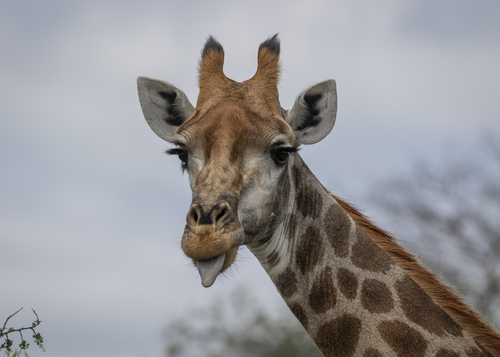
Southern Giraffe
Giraffa giraffa
The Southern Giraffe is the silent sentinel of the African bush, roaming the canopy with a grace that belies its massive scale. Recognizable by its star-shaped spots that reach the hooves, this gentle giant is a masterpiece of evolutionary engineering.
Quick Identification
Size
Height: 4.3–5.7 meters (14–19 ft); Weight: 700–1,500 kg (1,540–3,300 lbs)
Colors
Tan or cream base with dark brown, star-shaped or jagged patches that extend all the way down to the hooves
Key Features
- Two fur-covered ossicones (horns) on the head
- Jagged, irregular patches extending down the legs
- Prehensile blue-black tongue up to 18 inches long
- Sloping back with a long, dark-tufted tail
When You’ll See Them
Sightings on EverydayEarth
Jul 31, 2026
A bustling scene in a woodland clearing features a group of giraffes and a large herd of zebras. The giraffes are actively browsing on the leaves of a dense green bush in the center and several trees in the background, using their long necks to reach the foliage. In the foreground, dozens of zebras are gathered, some grazing on the sparse grass while others stand alert or shift through the group.
Jul 30, 2026
A giraffe stands at the edge of a watering hole under the morning sun. It cautiously lowers its long neck to drink from the surface, creating a clear reflection in the still water while its long legs are splayed slightly for balance.
Jul 27, 2026
A bustling morning at the waterhole features a large herd of African Elephants drinking and wading. A Southern Giraffe makes its way across the landscape in the background, while a Plains Zebra stands near the water's edge.
Jun 24, 2026
Three giraffes are gathered at a water pan in the bright morning light. One individual in the foreground leans down, splaying its front legs to reach the water to drink, while the other two stand nearby in the dry woodland landscape.
Jun 20, 2026
A lone giraffe approaches a waterhole under an overcast sky. It carefully splays its front legs wide—a vulnerable but necessary posture—to lower its long neck and drink from the surface.
Jun 20, 2026
A Plains Zebra is seen grazing on the dry grass in the foreground to the left of a waterhole. Behind it, a Southern Giraffe stands partially obscured by the surrounding bush, looking toward the camera. The water in the basin is still, reflecting the grey sky.
Behavior
These giants spend the majority of their day browsing—up to 18 hours—moving with a unique 'pacing' gait where both legs on one side move forward together. Despite their size, they are surprisingly agile and can reach speeds of 35 mph when pressed. In the wild, they serve as the 'watchtowers' of the savanna, as their height allows them to spot predators from great distances, often alerting other species like zebras and wildebeests to danger.
EverydayEarth exclusive
Camera Tips
To successfully capture a Southern Giraffe on a trail camera, you must account for their incredible height. If you mount a camera at the standard waist-high level used for deer or leopards, you will likely only record a series of long, moving legs. For the best head-and-shoulder shots, secure your camera to a sturdy tree at a height of 7 to 9 feet, angling the lens slightly upward. If you are aiming for full-body portraits, place the camera further back—at least 40 feet—from a high-traffic area like a preferred browsing tree or a salt lick.
Water holes are prime locations for camera placement because they force these giants into a vulnerable and photogenic 'tripod' stance. To drink, a giraffe must splay its front legs wide or kneel, bringing its head down to ground level. This is your best opportunity for close-up facial shots. Set your camera to a high-speed multi-shot burst mode; because giraffes move with a slow, sweeping motion, a single frame might capture a blurry neck or miss the head entirely as it passes through the frame.
Lighting is crucial for capturing the intricate patterns of their coat. During the day, the harsh African sun can wash out the tan-and-brown contrast, so try to position your camera facing North or South to avoid direct lens flare. At night, ensure your camera has a powerful long-range Infrared (IR) flash. While giraffes are less active at night, they do move between resting spots, and an IR-capable camera will capture them as haunting, majestic 'white ghosts' against the dark bushveld.
Frequently Asked Questions
Record Southern Giraffe at your habitat
Connect a camera to start building your own species record — AI identifies every visitor automatically.