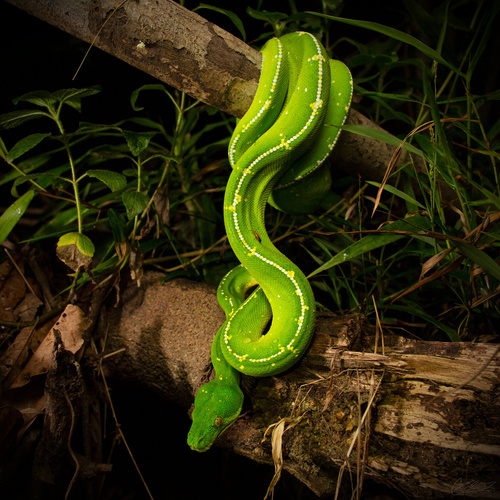
Southern Green Python
Morelia viridis
An emerald icon of the tropical canopy, the Southern Green Python is famous for its striking color and unique coiled resting pose. This elusive arboreal predator is a bucket-list find for any backyard wildlife enthusiast in the tropics.
Quick Identification
Size
Adults typically reach 1.5–2 metres (5–6.6 ft) in length and weigh between 1.2–1.6 kg (2.6–3.5 lb).
Colors
Brilliant emerald green adults, often with a white or yellowish vertebral stripe; juveniles are strikingly different, appearing bright lemon yellow, gold, or even dark maroon.
Key Features
- Distinctive diamond-shaped head with heat-sensing pits
- Vertical 'cat-like' pupils
- Iconic coiled resting posture over branches
- Prehensile tail used for gripping limbs
When You’ll See Them
Geographic range
Where Does the Southern Green Python Live?
Native to the Australasian tropics, the Southern Green Python is primarily found across the southern lowlands of New Guinea and the Aru Islands. Its range extends into the northernmost tip of Australia, specifically within the lush rainforests of the Cape York Peninsula in Queensland. While closely related species exist in northern New Guinea, this specific lineage is the iconic green snake of the Australian and Southern Papuan tropics.
Basemap © OpenStreetMap contributors
Behavior
The Southern Green Python is a master of the canopy, spending almost its entire life above the ground. It is most famous for its unique resting posture, where it coils its body neatly over a horizontal branch and rests its head right in the center of the loops. This sedentary behavior allows it to remain perfectly camouflaged among the leaves during the day, avoiding predators like hawks and owls.
As a nocturnal predator, this snake becomes active after dusk. It uses a 'sit-and-wait' ambush strategy, hanging its front section off a branch to strike at unsuspecting prey passing below. While generally solitary and docile if left alone, they are highly territorial regarding their preferred hunting perches. In human-populated areas on the edge of rainforests, they are occasionally seen in gardens but generally prefer the deep cover of primary forest.
EverydayEarth exclusive
Camera Tips
Capturing a Southern Green Python requires a shift in perspective—you must look up. Standard ground-level trail camera setups will almost never catch this species. Mount your camera 2 to 4 metres high, focusing on horizontal branches that are roughly the thickness of a human wrist, as these are the preferred resting spots for the species. Angle the camera slightly downward across the length of the branch to capture their iconic coiled silhouette.
Because these pythons are cold-blooded and move very slowly, standard Passive Infrared (PIR) sensors may fail to trigger. For the best results, use a camera with a high-sensitivity setting or utilize 'Time Lapse' mode during the night hours (6 PM to 6 AM) at 1-minute intervals. This ensures you capture the snake even if its body temperature matches the surrounding foliage.
Lighting is crucial. Southern Green Pythons are active at night, so a camera with a high-quality 'No-Glow' or 'Black IR' flash is essential to avoid spooking the animal or washing out the brilliant green scales in the image. If you are setting up near a known 'shedding' site or a frequent hunting perch, ensure there are no moving leaves directly in front of the lens, as tropical winds can lead to thousands of false triggers in the dense canopy.
Similar Species
Species that look similar or are commonly confused with Southern Green Python.
Frequently Asked Questions
Record Southern Green Python at your habitat
Connect a camera to start building your own species record — AI identifies every visitor automatically.