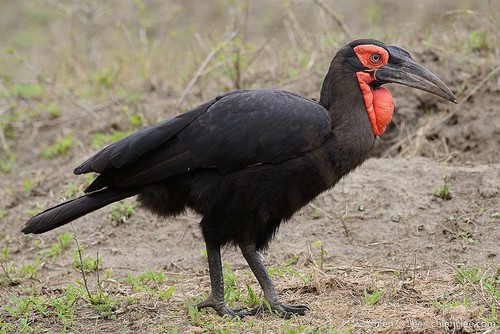
Southern Ground Hornbill
Bucorvus leadbeateri
The Southern Ground Hornbill is a majestic, ground-dwelling giant known for its vivid red face and deep, lion-like booming calls. As the largest hornbill in the world, this 'thunder bird' is a fascinating social predator that patrols the African savanna in tight-knit family groups.
Quick Identification
Size
Length: 90-129 cm (35-51 in); Weight: 2.2-6.2 kg (4.8-13.7 lbs); Wingspan: 1.2-1.8 m (4-6 ft)
Colors
Primary plumage is a deep, matte black; striking white primary feathers are highly visible only during flight; throat and facial skin are vivid scarlet red; females feature a patch of violet-blue on the throat sac.
Key Features
- Massive, downward-curving black bill with a small casque on top
- Bright red inflatable throat sac and bare facial skin
- Extremely long, prominent black eyelashes
- Stately, turkey-like walking gait primarily on the ground
When You’ll See Them
Behavior
The Southern Ground Hornbill is a highly social and intelligent bird, typically moving in family groups of two to ten individuals. These groups are cooperative breeders, consisting of a dominant breeding pair and several male 'helpers' who assist in defending the territory and providing food for the nesting female and chick. Their social structure is complex, and they are known for their deep, rhythmic 'booming' vocalizations that can be heard up to 5 kilometers away, often used to mark territory at dawn.
Unlike most hornbills, this species is primarily terrestrial, spending about 70% of its day walking slowly through the grass in search of prey. Despite their ground-dwelling nature, they are strong fliers and will retreat to the canopy of large trees at night to roost safely away from predators. In areas where they border human settlements, they are known for their curiosity and can sometimes be seen investigating reflections in windows or vehicles, occasionally pecking at them aggressively if they perceive the reflection as a territorial rival.
EverydayEarth exclusive
Camera Tips
To capture the Southern Ground Hornbill on a trail camera, placement is everything. Since these birds spend the vast majority of their time on foot, you must set your camera low to the ground—ideally between 30 and 50 centimeters (12-20 inches) high. Use a wide-angle lens setting if available, as these are large birds that travel in groups; a narrow field of view might only capture a tail feather or a single leg as the family troop marches past.
Because they are wary but curious, placing your camera near 'transition zones' is highly effective. Look for edges where thick bush meets an open lawn or mowed pathway, as they prefer foraging in areas where the grass is short enough to spot prey. If you are in a residential area bordering a park, a ground-level birdbath or a shallow water feature can be an excellent lure. They are quite heavy, so ensure your water basin is sturdy and large enough to accommodate a bird the size of a small turkey.
Lighting is your best friend for a 'hero shot' of this species. Aim your camera to catch the morning sun, which highlights the brilliant red of their throat sacs against their black feathers. Use a fast trigger speed (0.5 seconds or less) and a multi-shot burst mode. While they walk slowly, their bill strikes are incredibly fast, and you’ll want multiple frames to capture the moment they snatch up an insect or lizard. Avoid placing the camera near glass windows if you want to record natural behavior, as they may stop foraging to fight their own reflection.
Similar Species
Species that look similar or are commonly confused with Southern Ground Hornbill.
Frequently Asked Questions
Record Southern Ground Hornbill at your habitat
Connect a camera to start building your own species record — AI identifies every visitor automatically.