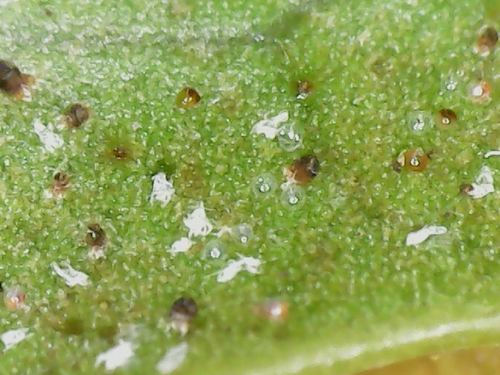
Southern Red Mite
Oligonychus ilicis
The Southern Red Mite is a vibrant, microscopic gem of the backyard ecosystem. While tiny in stature, these ruby-colored arachnids create intricate worlds of silk on the leaves of our favorite garden evergreens.
Quick Identification
Size
0.3 to 0.5 mm (0.01 to 0.02 inches) in length
Colors
Deep reddish-brown to bright maroon body; legs and front of body are typically paler, translucent or tan
Key Features
- Dark red oval-shaped body
- Eight pale legs (adults)
- Produces very fine silk webbing on leaf undersides
- Feeding causes 'stippling' or bronzing on foliage
When You’ll See Them
Geographic range
Where Does the Southern Red Mite Live?
Originally native to East Asia, including Japan, the Southern Red Mite has become a globally distributed species due to the international trade of ornamental plants. It is now a permanent resident throughout the eastern United States, from the Gulf Coast to the Great Lakes, and is also widely established in Brazil and parts of Western Europe. It thrives wherever its preferred host plants, such as Camellias and Hollies, are used in landscaping.
Basemap © OpenStreetMap contributors
Behavior
These mites are prolific silk-spinners, though their webbing is much finer and less obvious than that of the common Two-spotted Spider Mite. They use the silk as a protective canopy against predators and as a structural highway for moving across the leaf surface. While they are tiny, their presence is often signaled by the 'bronzing' of leaves, a result of thousands of tiny bite marks where the mites have drained the plant's chlorophyll.
In terms of social structure, they are loosely colonial. They don't cooperate in a traditional sense, but their high reproductive rate leads to dense populations. In suburban environments, they are frequently found in managed landscapes, particularly where broadleaf evergreens are used for hedging.
EverydayEarth exclusive
Camera Tips
Because these mites are 'cool-season' pests, your best window for photography is during the spring or fall when temperatures hover between 60°F and 80°F. Look for plants showing 'stippling'—a dusting of tiny white or yellow spots on the upper leaf surface. This is a tell-tale sign that mites are active on the underside of that specific leaf. Secure the leaf to a steady surface or use a 'plamp' (plant clamp) to prevent wind blur, which is the biggest enemy of macro photography.
Lighting is critical. Since the mites live on the shaded undersides of leaves, use a diffused LED ring light or a side-lit flash to bring out their deep red color and the texture of their silk webbing. Avoid direct, harsh sunlight, which can wash out the translucent details of their legs. Set your camera to a high frame rate or burst mode to capture their surprisingly quick crawling movements.
Similar Species
Species that look similar or are commonly confused with Southern Red Mite.
Frequently Asked Questions
Record Southern Red Mite at your habitat
Connect a camera to start building your own species record — AI identifies every visitor automatically.