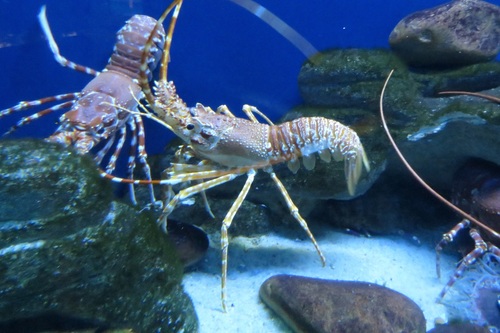
Southern Spiny Lobster
Palinurus gilchristi
The Southern Spiny Lobster is the armored king of the South African continental shelf. A social scavenger known for its vibrant orange hues and impressive migrations, it thrives in the deep, rocky reefs of the Agulhas Bank.
Quick Identification
Size
Carapace length 6–16 cm (2.4–6.3 in); total body length up to 40 cm (15.7 in); weight up to 1.5 kg (3.3 lbs)
Colors
Deep reddish-orange to pinkish-brown carapace; abdomen often features lighter spots or cream-colored bands; legs are pale with dark orange-red stripes.
Key Features
- Spiny, robust carapace lacking large front claws
- Two exceptionally long, thick antennae used for defense and sensing
- A series of forward-pointing spines along the back and sides
- Large, fan-shaped tail used for rapid backward swimming
When You’ll See Them
Geographic range
Where Does the Southern Spiny Lobster Live?
Where Does the Southern Spiny Lobster Live? This species is a true South African endemic, found exclusively in the temperate waters off the southern coast of Africa. Its primary range spans the Agulhas Bank, stretching from the Cape of Good Hope in the west to East London in the east. While they are occasionally found in deeper waters further north, their highest population densities are concentrated on the rocky substrates of the southern continental shelf.
Basemap © OpenStreetMap contributors
Behavior
The Southern Spiny Lobster is a social but cautious inhabitant of the deep seafloor. Unlike many solitary crustaceans, these lobsters are often found in large communal groups, sheltering together in rocky crevices or under ledges during the day. This gregarious behavior is a key survival strategy, as a group of lobsters can use their long, stiff antennae to create a perimeter of 'spears' that deters predators like octopuses and small sharks.
When night falls, the Southern Spiny Lobster becomes an active explorer. They emerge from their rocky fortresses to forage across the benthos, using their highly developed chemoreceptors on their smaller antennules to 'smell' food in the water column. If threatened, they employ a dramatic 'caridoid escape reaction,' rapidly snapping their powerful tails to propel themselves backward into the darkness at high speeds.
EverydayEarth exclusive
Camera Tips
Capturing the Southern Spiny Lobster on camera is a rewarding challenge that requires moving beyond the traditional backyard setup into the realm of marine exploration. Because these lobsters live at significant depths on the continental shelf, you will need a specialized underwater housing rated for at least 100 meters, or better yet, a tethered ROV (Remotely Operated Vehicle) or a 'drop-camera' system. Standard trail cameras will not survive the pressure or the saltwater environment at these depths.
Lighting is the most critical factor for a clear shot. At 50+ meters, the ocean is nearly devoid of natural light. Use dual wide-beam LED video lights to eliminate harsh shadows. However, be aware that these lobsters are sensitive to sudden changes in light. If possible, use lights with a 'ramp-up' feature or red filters; lobsters have limited sensitivity to red light, which may allow you to observe their natural foraging behavior without startling them back into their burrows.
To attract the Southern Spiny Lobster to your lens, use a bait cage. Oily fish such as sardines, or crushed local mollusks like mussels, work best to create a scent trail that carries through the bottom currents. Position the camera about 1-2 meters away from a known rocky outcropping or reef edge, angling it slightly downward to catch the lobsters as they crawl across the sandy-rocky interface. Ensure your rig is heavily weighted, as the currents on the Agulhas Bank can be surprisingly strong.
For the best footage, set your camera to a high frame rate (60fps) to capture their lightning-fast tail-flip escapes. If you are using a stationary drop-camera, leave it deployed for at least 2-4 hours during the night. Patience is vital; often, smaller fish and invertebrates will arrive at the bait first, with the more cautious Southern Spiny Lobsters appearing once they feel the area is safe from larger predators.
Frequently Asked Questions
Record Southern Spiny Lobster at your habitat
Connect a camera to start building your own species record — AI identifies every visitor automatically.