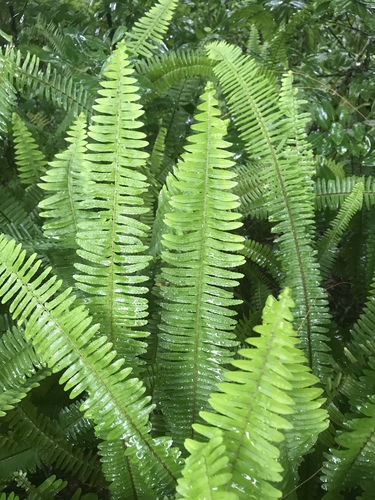
southern sword fern
Nephrolepis exaltata
With its iconic arching fronds and vibrant green hue, the southern sword fern is the quintessential backyard fern. It creates a lush, prehistoric atmosphere while providing a vital humid sanctuary for garden-dwelling critters.
Quick Identification
Size
Fronds typically 40–90 cm (16–35 in) long, occasionally reaching 1.5 m (5 ft)
Colors
Bright vibrant green to deep emerald green; underside of pinnae may show brown spore clusters (sori)
Key Features
- Long, sword-shaped arching fronds
- Serrated leaflets (pinnae) with a slight 'fishbone' appearance
- Absence of tubers on roots (unlike similar species)
- Dense, clump-forming habit with hairy runners (stolons)
When You’ll See Them
Geographic range
Where Does the southern sword fern Live?
Native to the tropical and subtropical regions of the Americas, the southern sword fern is most at home in the moist, shaded environments of Florida, Mexico, and the West Indies. Its range extends deep into Central and South America, thriving in the humid lowlands of Brazil and Colombia. Beyond its native borders, it has been widely introduced and naturalized in tropical regions worldwide, including parts of Africa, Asia, and Polynesia, where it often escapes gardens to inhabit local woodlands.
Basemap © OpenStreetMap contributors
Behavior
The southern sword fern is a hardy, perennial evergreen known for its resilient growth habit. It primarily spreads through stolons—long, thin runners that creep across the soil surface to establish new plant clumps. This colonial behavior allows it to create dense thickets that provide excellent ground cover for small amphibians and insects. While it doesn't move like an animal, the southern sword fern is highly responsive to its environment; its fronds will noticeably droop during periods of low humidity or drought and quickly revive once moisture is restored.
In a backyard setting, this fern often acts as a focal point for local micro-ecosystems. It has a symbiotic relationship with humid air and filtered sunlight, often thriving in the shadows of larger trees. Because of its dense foliage, it serves as a preferred nesting site for some ground-nesting birds and a humid retreat for tree frogs. For humans, it is a low-maintenance landscape favorite that effectively filters toxins and increases local humidity levels.
EverydayEarth exclusive
Camera Tips
Capturing the southern sword fern on a backyard camera requires a different strategy than photographing mobile wildlife. Because ferns are stationary, they make for incredible subjects for time-lapse photography. Set your AI camera to take a photo every hour over the course of a week to witness the 'circinate vernation'—the fascinating way the young fronds, or fiddleheads, slowly unfurl from the center of the plant. This is most dramatic in early spring or after a heavy rain event.
For those looking to capture wildlife using the fern, place your camera at a low angle, approximately 6 to 12 inches off the ground, pointed toward the base of the plant. Many small reptiles, such as anoles, and amphibians like tree frogs use the dense fronds for cover. By focusing on the gaps between the arching leaves, you can trigger your camera as these animals move through their green 'tunnel' system. High-trigger speed is essential here, as these creatures move quickly through the foliage.
Lighting is the biggest challenge when filming ferns. Since they thrive in shade, the lighting can often be dappled, which may confuse some motion sensors or lead to overexposed 'hot spots' in your photos. Position your camera to face north if possible, which ensures more consistent, indirect light across the green fronds. If your camera has adjustable settings, a slightly lower exposure compensation can help preserve the deep green textures and prevent the bright highlights from 'blowing out' on sunny days.
Lastly, don't ignore the movement of the fern itself. On windy days, the swaying of long fronds can create beautiful motion-blur sequences. If you are using a camera with a video mode, capturing the fern during a rainstorm provides a great look at how the plant sheds water. The reflective nature of wet fronds can also improve nighttime IR (infrared) captures, providing better contrast if an animal happens to wander by the plant at night.
Frequently Asked Questions
Record southern sword fern at your habitat
Connect a camera to start building your own species record — AI identifies every visitor automatically.