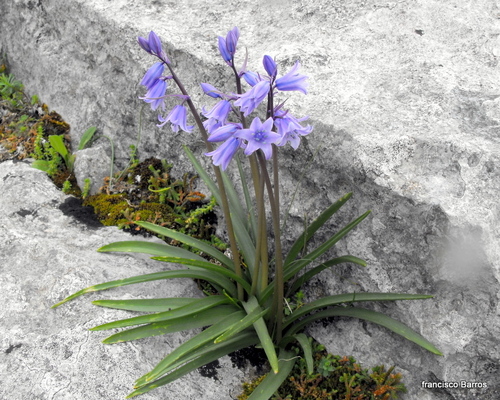
Spanish Bluebell
Hyacinthoides hispanica
A robust and cheerful herald of spring, the Spanish Bluebell brightens shady garden corners with its sturdy spikes of nodding, azure bells.
Quick Identification
Size
Stems reach 30–50 cm (12–20 inches) in height; leaves are 20–50 cm (8–20 inches) long.
Colors
Typically pale violet-blue, but also found in pink or white; features distinct blue anthers (pollen-bearing parts).
Key Features
- Upright stems with flowers blooming on all sides
- Wide, bell-shaped flowers with spreading petal tips
- Pale blue anthers/pollen
- Broad, strap-shaped leaves measuring 2-3 cm wide
- Lacks the strong scent of the English variety
When You’ll See Them
Behavior
The Spanish Bluebell is a vigorous, bulbous perennial known for its hardy nature and ability to spread rapidly through both seed dispersal and the production of underground bulb offsets. Unlike many delicate woodland flowers, this species is exceptionally resilient, often thriving in conditions where other plants struggle. It is a classic 'spring ephemeral,' meaning it completes its life cycle quickly in the early spring before the forest canopy closes and blocks out the sun.
In the backyard ecosystem, Spanish Bluebells act as a vital early-season nectar source for pollinators emerging from winter dormancy. You will often see bumblebees and hoverflies visiting the wide, open bells. However, it is worth noting that in certain regions like the UK, this species is considered a 'garden escapee' that can hybridize with native bluebells, creating a more robust hybrid that can outcompete local flora.
EverydayEarth exclusive
Camera Tips
Capturing the Spanish Bluebell on a backyard camera requires a different approach than moving wildlife. To truly showcase its beauty, use the 'Time-Lapse' mode on your camera. Set your device to take a photo every 30 to 60 minutes over a period of two weeks in late April. This will allow you to create a stunning video of the 'flower spike' emerging from the foliage and the individual bells unfurling from bottom to top.
For the best perspective, mount your camera on a ground stake or a very low tripod, positioning the lens just 6 to 10 inches above the soil. Aim for a slightly upward angle to capture the interior of the bell-shaped flowers and the sky or canopy in the background. Because these flowers thrive in dappled shade, lighting can be tricky; try to position the camera so the morning sun backlights the petals, which gives them a translucent, glowing quality in photos.
If you are using a trigger-based camera to catch pollinators, set your PIR (Passive Infrared) sensitivity to high, but be aware that wind moving the flower stems might cause false triggers. Use a 'Macro' or 'Close-up' focus setting if your camera allows it. This is essential for capturing the unique blue color of the pollen on the anthers, which is a primary identifying feature. Since these plants don't move fast, you can lower your shutter speed to gather more light in dark woodland settings, ensuring the vibrant blue hues don't look muddy or gray.
Similar Species
Species that look similar or are commonly confused with Spanish Bluebell.
Frequently Asked Questions
Record Spanish Bluebell at your habitat
Connect a camera to start building your own species record — AI identifies every visitor automatically.