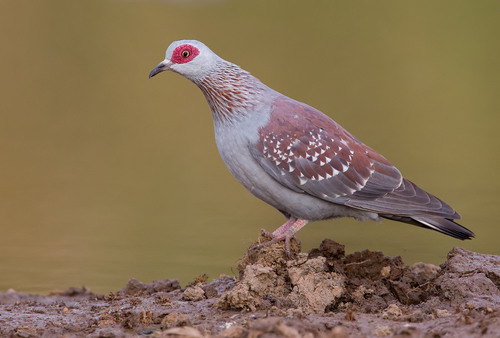
Speckled Pigeon
Columba guinea
With its striking red eye-patches and beautifully patterned 'speckled' wings, this hardy African native is a master of adaptation. Whether perched on a rocky cliff or a suburban rooftop, the Speckled Pigeon brings a bold, rhythmic energy to any backyard camera feed.
Quick Identification
Size
Length: 32–34 cm (12.5–13.5 in); Wingspan: 60–70 cm (24–27.5 in); Weight: 250–390 g (8.8–13.8 oz)
Colors
Slate-grey head and underparts with maroon-brown back and wings. Distinctive white triangular spots on the wing coverts and a prominent patch of red bare skin around the eyes. Sexes are virtually identical.
Key Features
- Prominent red patch of bare skin around the eyes
- White triangular spots on maroon-brown wing feathers
- Bifurcated neck feathers that create a hackled appearance
- Stout, slate-grey body with a rounded tail
When You’ll See Them
Behavior
The Speckled Pigeon is a highly social and adaptable bird, often found in pairs or large, noisy flocks. Originally a cliff-dweller, it has transitioned seamlessly into urban environments, where it treats tall buildings and ledges like its ancestral rocky crags. You will frequently see them strutting across open ground with a rhythmic head-bobbing motion as they search for food. They are known for their loud, rhythmic cooing—a series of deep 'doo-doo-doo' notes that can be heard from rooftops throughout the day.
While they are generally peaceful, Speckled Pigeons can be quite assertive at feeding stations, often displacing smaller birds. They have a unique way of drinking, submerging their bill and sucking up water continuously rather than sipping and tilting their head back like most birds. In flight, they are powerful and direct, showing off their broad wings and characteristic 'rock pigeon' silhouette.
EverydayEarth exclusive
Camera Tips
To capture the best footage of a Speckled Pigeon, position your AI-powered camera low to the ground, ideally between 6 to 12 inches high. Since these birds are dedicated ground-feeders, a camera angled slightly downward toward a flat, open patch of soil or short grass will yield the most intimate 'strutting' shots. If you have a patio or a flat stone wall, these also make excellent stages for the pigeons to land and display their plumage.
Water is one of the most effective lures for this species. A wide, shallow birdbath placed in a sunny spot will attract them daily. Because they drink by suction, they often stay at the water's edge for several seconds, providing ample time for your camera’s AI to trigger and focus. Place your camera 3-5 feet away from the water source to ensure the bird’s entire body and those striking red eye patches are in clear focus without being cropped out.
If you are using bait to draw them in, scattered cracked corn, sunflower seeds, or bird millet will work wonders. To get the highest quality images, set your camera's shutter speed to a faster setting if possible, as their head-bobbing motion can sometimes cause motion blur in lower light. Early morning light is particularly flattering for this species, as it highlights the iridescent pink and green sheen on their neck hackles.
During the breeding season, you might capture unique social behaviors such as 'billing' (where the pair touches beaks) or the male's bowing display. Ensure your camera is set to record short video clips rather than just still photos to capture these rhythmic movements and their distinctive vocalizations, which add a wonderful layer of context to your backyard wildlife discoveries.
Frequently Asked Questions
Record Speckled Pigeon at your habitat
Connect a camera to start building your own species record — AI identifies every visitor automatically.