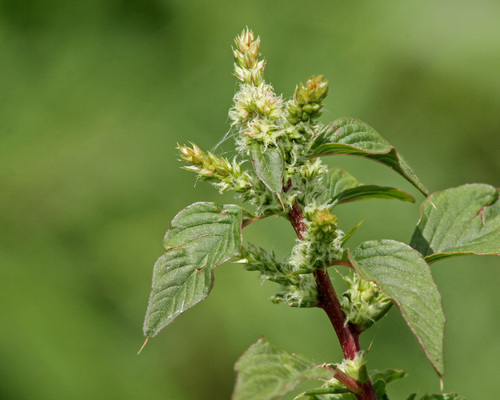
spiny amaranth
Amaranthus spinosus
Armed with needle-sharp spines and a resilient spirit, the spiny amaranth is a fascinating survivor of the backyard landscape. This rapid-growing summer annual turns disturbed soil into a fortress of green spikes and towering seed heads.
Quick Identification
Size
Typically 1–3 feet (30–90 cm) tall, though it can reach up to 5 feet (150 cm) in ideal soil conditions.
Colors
Bright green to reddish-maroon stems; green leaves often with a faint 'V' shaped watermark; greenish-white or yellowish flower spikes.
Key Features
- Pairs of sharp, stiff spines (0.5–1 cm long) at the base of leaves
- Tall, slender flower spikes at the top of the plant
- Reddish-tinged stems, especially near the base
- Diamond-shaped leaves with prominent veins
When You’ll See Them
Behavior
Spiny amaranth is a highly resilient annual herb that thrives in disturbed environments. Unlike many of its cousins in the pigweed family, this species has evolved a fierce defense system: sharp, needle-like spines located at the leaf axils. These spines deter herbivores from grazing, allowing the plant to reach maturity even in high-traffic areas like pastures or garden edges. It is a prolific seed producer, with a single plant capable of releasing tens of thousands of tiny black seeds that can remain dormant in the soil for years.
As a 'C4' plant, the spiny amaranth is incredibly efficient at photosynthesis, allowing it to grow rapidly during the peak heat of summer when other plants might wilt. While it is often classified as a noxious weed because it competes with crops and can injure livestock, it also serves as a micro-habitat for various specialized insects. In backyard settings, it acts as a pioneer species, quickly colonizing bare patches of dirt to prevent erosion before other plants can take hold.
EverydayEarth exclusive
Camera Tips
To get the best identification shots of spiny amaranth, you should focus on the 'armored' parts of the plant. Position your AI-powered camera at a low-to-medium height—about 18 inches from the ground—aimed at the junction where the leaves meet the main stem. This is where the characteristic pairs of spines are located. Using a camera with a good macro or close-up focus capability is essential here, as the spines can be thin and easily lost against a busy background.
Lighting plays a major role in highlighting the structural details of this species. Early morning or late afternoon light (the 'golden hour') is best, as the low sun angle creates sharp shadows that make the spines and the texture of the flower spikes pop. If your camera is positioned in a shaded area, the fine details of the greenish flowers might appear as a blurry mass, making it harder for AI algorithms to differentiate it from other pigweeds. If possible, clear away any surrounding tall grass that might blow in front of the lens and trigger false motion alerts.
Because this is a plant, a time-lapse setting is your best friend. Set your camera to take one photo every 2-4 hours over several weeks. This will allow you to capture the impressive speed at which the spiny amaranth develops its terminal flower spikes. Additionally, if you are interested in the local ecosystem, high-speed 'burst' settings can help you capture the small beetles and pollinators that occasionally visit the plant, even though it is primarily wind-pollinated.
Placement is key for safety as well as photography. Avoid placing your camera in a spot where you have to reach through the plant to retrieve the SD card or change batteries, as those spines are incredibly sharp and can easily pierce through gardening gloves. Select a specimen that stands alone rather than in a thicket to ensure the AI can clearly see the plant's silhouette and branching pattern.
Frequently Asked Questions
Record spiny amaranth at your habitat
Connect a camera to start building your own species record — AI identifies every visitor automatically.