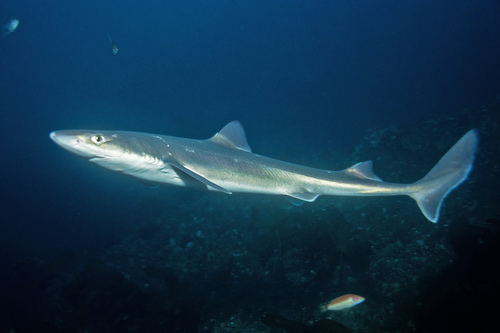
Spiny Dogfish
Squalus acanthias
The ocean's most sophisticated traveler, the Spiny Dogfish is a master of the deep. Recognizable by its white-spotted coat and defensive dorsal spines, this small shark brings a touch of prehistoric wonder to coastal waters.
Quick Identification
Size
Adults typically range from 31 to 49 inches (80–125 cm) in length and weigh between 7 and 10 lbs (3–4.5 kg), with females growing much larger than males.
Colors
Slate gray to brownish-gray on the upper body with a contrasting white or pale belly; young and most adults feature distinct white spots along their flanks.
Key Features
- Two sharp venomous spines located in front of each dorsal fin
- Absence of an anal fin
- Streamlined, slender body with a distinctly pointed snout
- White spots scattered along the sides of the body
When You’ll See Them
Behavior
Spiny Dogfish are highly social and migratory sharks, often traveling in massive, dense schools that can include thousands of individuals. Interestingly, these schools are frequently segregated by both size and sex, meaning a group of dogfish off a local pier might be entirely composed of mature females. They are known for their incredible endurance, with some tagged individuals traveling thousands of miles during seasonal migrations in search of temperate waters between 45°F and 60°F.
Despite being sharks, they pose very little threat to humans, though their dorsal spines are mildly venomous and can cause a painful wound if handled carelessly. They are opportunistic and bold hunters, often nicknamed the 'hounds of the sea' for their tendency to hunt in packs to overwhelm schools of smaller fish. Their slow metabolism is balanced by a remarkably long lifespan, with some individuals estimated to live over 70 years in the wild.
EverydayEarth exclusive
Camera Tips
To capture Spiny Dogfish on camera, you will need a specialized underwater setup or a waterproof action camera (like a GoPro) mounted to a weighted submersible housing. If you have a backyard dock or live on a canal, the best placement is between 5 and 15 feet deep. Use a weighted tripod or a 'crab pot' style mount to keep the camera steady against tidal currents. Aim the lens horizontally across the seafloor or slightly upward toward the surface to capture the silhouette of the shark’s distinctive dorsal fins and spines.
Attracting these sharks is all about scent. Secure a mesh 'chum bag' filled with oily fish like smashed sardines, mackerel, or menhaden about three feet in front of the camera lens. Spiny Dogfish have an incredibly sensitive sense of smell and will often arrive within minutes of the scent hitting the water. Ensure the bait is secured tightly so they don't swim off with the entire lure, giving you more time to record their social interactions.
Regarding camera settings, use a high frame rate (at least 60fps) because while they look slow, their strike and turns are lightning-fast. Since light dissipates quickly underwater, try to film during mid-morning when the sun is directly overhead to illuminate the white spots on their backs. If you are filming in deeper, murkier water, use a wide-angle lens to maximize the field of view and keep the focus set to 'Landscape' or 'Infinity' to ensure the sharks stay in focus as they cruise past the bait.
Seasonal timing is crucial for coastal observers. In many regions, Spiny Dogfish move into shallower 'backyard' bays during the spring to pup or during the fall migration. Monitor local water temperature—once it hits that 50°F sweet spot, it is time to get your cameras in the water. Avoid filming during heavy siltation events, such as immediately after a storm, as the suspended sand will reflect your camera's light and obscure the shark's features.
Frequently Asked Questions
Record Spiny Dogfish at your habitat
Connect a camera to start building your own species record — AI identifies every visitor automatically.