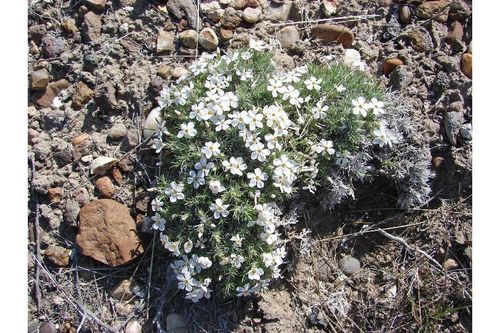
spiny phlox
Phlox hoodii
A tough-as-nails survivor of the American West, Spiny Phlox turns rocky, barren soils into a sea of white blossoms every spring. This low-growing beauty is a master of desert survival and a crucial first stop for early-season pollinators.
Quick Identification
Size
Height of 2–10 cm (1–4 inches); forms mats or cushions up to 30 cm (12 inches) wide
Colors
Brilliant white to pale lavender or light pink flowers; grey-green to dark green needle-like foliage
Key Features
- Dense, cushion-forming growth habit
- Sharp, needle-like (spiny) leaves tipped with a small point
- Five-petaled flowers with a narrow, tubular base
- Early spring bloomer appearing shortly after snowmelt
When You’ll See Them
Geographic range
Where Does the spiny phlox Live?
Spiny Phlox is native to the vast landscapes of Western North America, stretching from the arctic tundra of Alaska and the Yukon down through the Canadian Prairies. Its core range includes the American West, particularly the Great Basin and Rocky Mountain states, reaching as far south as the arid highlands of Arizona and New Mexico. It is most commonly found in the 'sagebrush sea' and rocky outcrops where it thrives in well-drained, open terrain.
Basemap © OpenStreetMap contributors
Behavior
Spiny Phlox is a resilient perennial known for its 'cushion' or 'mat' growth habit. This low-profile structure is an evolutionary adaptation to the harsh, windy environments of the western plains and mountain foothills. By staying close to the ground, the plant creates its own microclimate, trapping heat and reducing moisture loss from the drying winds of the high desert. The leaves are covered in tiny, fine hairs that further assist in water conservation.
As one of the earliest bloomers in its range, Spiny Phlox plays a critical ecological role. It provides a vital nectar source for early-emerging pollinators, such as beeflies and small butterflies, at a time when few other flowers are available. While it appears delicate during its peak bloom, the plant is incredibly hardy, supported by a deep woody taproot that allows it to survive in nutrient-poor lithosols (stony soils) where few other species can thrive.
EverydayEarth exclusive
Camera Tips
Photographing Spiny Phlox requires a different approach than typical wildlife. Because this plant rarely grows more than a few inches tall, you must get your camera down to ground level. Use a low-profile mount or a stake to position the lens just 2–5 inches above the soil. This perspective captures the 'carpet' effect of the blooms and reveals the intricate, needle-like details of the foliage that aren't visible from a standing height.
To capture the life surrounding the plant, set your camera to 'Time Lapse' mode during the daylight hours. A setting of one photo every 15 minutes is ideal for documenting the progression of the bloom over several days. If you are interested in the pollinators that visit Spiny Phlox, use a camera with a fast trigger speed and a high-resolution sensor. Since the flowers are small, a camera with macro capabilities or a close-focusing lens is necessary to get clear, sharp images of visiting insects like the white-lined sphinx moth or native bees.
Lighting is the biggest challenge when capturing the brilliant white petals. Direct midday sun can 'blow out' the highlights, leaving you with a featureless white blob. Aim to capture your best shots during the golden hours—shortly after sunrise or just before sunset—when the light is soft and directional. This lower-angle light will also highlight the texture of the 'spiny' leaves and the hairs on the plant, adding depth to your photos. If your backyard or trail camera has adjustable exposure settings, try underexposing by -0.5 to keep the petal details crisp.
Frequently Asked Questions
Record spiny phlox at your habitat
Connect a camera to start building your own species record — AI identifies every visitor automatically.