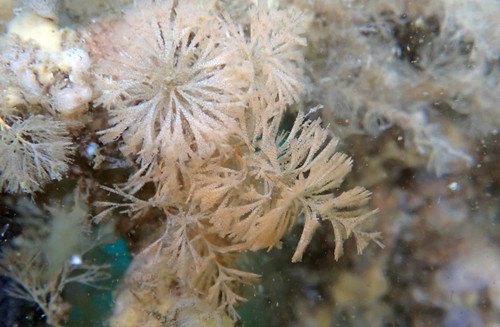
Spiral Bryozoan
Bugulina californica
Discover the mesmerizing architecture of the Spiral Bryozoan, a colonial marine animal that builds intricate, corkscrew-shaped cities. Often mistaken for seaweed, these 'moss animals' are master filter-feeders of the Pacific coast.
Quick Identification
Size
Colonies typically 2–5 cm (0.8–2 inches) in height; individual zooids are microscopic
Colors
Translucent white, cream, or light tan; occasionally pale yellow
Key Features
- Distinctive spiral or 'corkscrew' growth pattern
- Branching fern-like appearance
- Attached to surfaces by a root-like holdfast
- Translucent, delicate skeletal structure
When You’ll See Them
Geographic range
Where Does the Spiral Bryozoan Live?
The Spiral Bryozoan is native to the temperate coastal waters of the Eastern Pacific, with its core population stretching from British Columbia, Canada, southward through the United States to the coast of Baja California, Mexico. It is a common inhabitant of the California Current, thriving in the cold, nutrient-rich waters of the North American West Coast. In recent decades, it has also been documented as an introduced species in Japan and parts of the European coastline, likely spread through international shipping and mariculture.
Basemap © OpenStreetMap contributors
Behavior
Spiral Bryozoans are colonial animals that live in complex, tree-like structures. While they may look like delicate underwater plants, each colony is actually composed of hundreds of individual clones called zooids. These zooids are physically connected and share nutrients, working in unison to ensure the survival of the colony. They are sessile organisms, meaning they remain fixed to a single spot—such as a rock, kelp frond, or dock piling—for their entire adult lives.
The primary activity of the colony is filter feeding. Each zooid possesses a lophophore, a crown of tiny, hair-like tentacles coated in mucus. By waving these cilia, the colony creates micro-currents that pull water toward them, allowing them to trap microscopic food particles. When threatened by a predator, such as a sea spider or a nudibranch, the zooids can instantaneously retract their tentacles into their protective calcified 'boxes' for safety.
EverydayEarth exclusive
Camera Tips
Capturing the Spiral Bryozoan requires a specialized underwater approach since these animals live entirely submerged. For backyard enthusiasts with coastal property or dock access, a waterproof action camera like a GoPro equipped with a dedicated macro lens is the best tool. Because the colony’s spiral branches are small and intricate, you need to get the camera within 2 to 5 inches of the specimen. Use a weighted mini-tripod or a clamp to secure the camera to a dock piling to prevent 'camera shake' caused by water movement.
Lighting is the most important factor for making these translucent animals stand out. In the shadows under a dock, the Spiral Bryozoan can appear as a muddy grey clump. Use a high-CRI (Color Rendering Index) underwater video light positioned to the side of the colony. This side-lighting creates shadows that define the 'corkscrew' shape and highlights the delicate lophophores when they are extended. If the water is murky, placing the light even further to the side (45 to 90 degrees) helps reduce backscatter from floating particles.
For the clearest footage, aim to film during 'slack tide'—the window of time when the tide is neither coming in nor going out. This is when the water is most still and the clarity is at its highest. If you are using an AI-powered camera in a stationary underwater housing, set your focus to a fixed macro distance and look for a colony that is attached to a stable rock rather than swaying kelp. This ensures the animal stays within the narrow depth of field required for macro photography.
Frequently Asked Questions
Record Spiral Bryozoan at your habitat
Connect a camera to start building your own species record — AI identifies every visitor automatically.