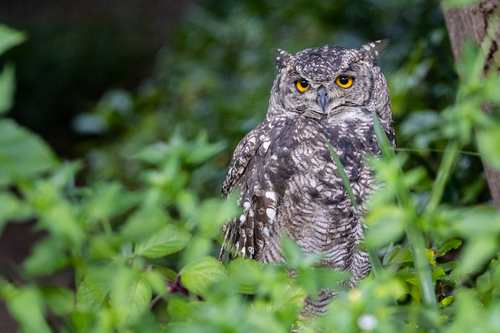
Spotted Eagle-Owl
Bubo africanus
With its iconic ear tufts and piercing yellow gaze, the Spotted Eagle-Owl is the ultimate nocturnal guardian of the garden. This resilient hunter has mastered the art of suburban living, bringing a touch of wild mystery to the night.
Quick Identification
Size
Length: 45 cm (18 in); Wingspan: 100–140 cm (39–55 in); Weight: 454–907 g (1–2 lbs)
Colors
Mottled dusky brown and white upperparts; off-white underparts with fine brown horizontal barring; striking yellow eyes.
Key Features
- Prominent, wide-set feather ear tufts
- Large, piercing yellow eyes
- Fine brown horizontal barring on the belly
- Dusky brown facial disk with a dark border
When You’ll See Them
Sightings on EverydayEarth
Jun 21, 2026
A Spotted Eagle-Owl is perched on a log in the foreground, overlooking a dark water pan. Despite a steady rain, the owl remains stationary while turning its head to scan the surrounding woodland.
Jun 9, 2026
A Spotted Eagle-Owl is perched on the dusty ground at night. Initially facing away from the camera, it showcases its intricate mottled plumage and prominent ear tufts. After several seconds of remaining still, it rotates its head sharply to the side to scan its surroundings.
Behavior
The Spotted Eagle-Owl is a highly adaptable predator that has become a familiar resident in many suburban environments. Despite their fierce appearance, they are relatively tolerant of human activity, often choosing to roost in garden trees or even nest on building ledges and window boxes. They are primarily solitary or found in pairs, maintaining territories through deep, resonant 'hoo-hoo' vocalizations that are often performed as a duet between mates during the breeding season.
During daylight hours, these owls rely on their intricate plumage to blend perfectly into tree bark or rocky crevices. When dusk arrives, they emerge to hunt from high vantage points like fence posts, rooftops, or low branches. They are known for a 'sit-and-wait' hunting strategy, scanning the ground for movement before launching into a silent, controlled dive to snatch their prey.
EverydayEarth exclusive
Camera Tips
To capture high-quality footage of a Spotted Eagle-Owl, you should focus your camera on high-traffic 'launch points.' These owls love consistent perches such as the top of a fence post, a garden gate, or a sturdy, flat branch that offers a clear view of a lawn. Position your camera approximately 3 to 6 feet high, tilted slightly upward if aiming at a perch, or level with the ground if you are targeting a known 'strike zone' where they hunt mice.
Because these owls are strictly nocturnal, a camera with 'No-Glow' or 'Invisible' infrared (IR) flash is non-negotiable. Standard white flashes or even some low-glow red LEDs can startle the bird or cause 'white-out' on their reflective feathers. Set your camera to a fast trigger speed (under 0.5 seconds) and use 'Burst Mode' for photos or a 20-second video clip. Owls move with incredible speed when diving; a slow trigger will result in a frame full of empty air or a blurry wing.
While you should never use live bait to attract owls, you can make your yard more 'owl-friendly' by leaving a corner of the garden wild to attract their natural prey like crickets and mice. If you have a birdbath, keep it full and clean. Spotted Eagle-Owls are frequent visitors to backyard water sources at night for drinking and bathing. Ensure your camera is set to its highest sensitivity at night, as an owl’s silent flight might not always trigger lower-end PIR sensors immediately.
Similar Species
Species that look similar or are commonly confused with Spotted Eagle-Owl.
Frequently Asked Questions
Record Spotted Eagle-Owl at your habitat
Connect a camera to start building your own species record — AI identifies every visitor automatically.