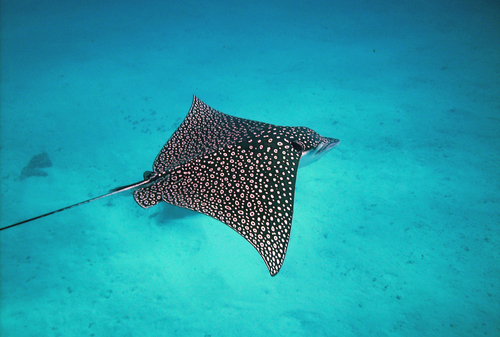
Spotted Eagle Ray
Aetobatus narinari
The Spotted Eagle Ray is the undisputed 'bird of the sea,' famous for its stunning white-spotted pattern and the way it gracefully glides through coastal waters. For those lucky enough to live near the water's edge, these majestic rays provide a breathtaking glimpse into the wonders of the deep.
Quick Identification
Size
Wingspan typically 4–8 feet (1.2–2.5 meters), with maximums reaching 10 feet (3 meters). Weight ranges from 40 to 500 lbs (18–230 kg).
Colors
Dark indigo, charcoal, or deep brown dorsal surface covered in a distinct pattern of white or cream-colored spots and rings; solid white underbelly (ventral side).
Key Features
- Broad, shovel-shaped 'duck-bill' snout used for foraging
- Long, whip-like tail equipped with one or more venomous spines at the base
- Distinctive pattern of white spots on a dark background
- Graceful, bird-like swimming motion using pectoral fins as 'wings'
When You’ll See Them
Sightings on EverydayEarth
Jun 16, 2026
A pair of Spotted Eagle Rays glides gracefully through the open water, showcasing their striking white-spotted patterns. The camera then captures a busier scene along the reef where a group of Nurse Sharks is seen swimming together. They are surrounded by active schools of fish, including Yellowtail Snappers and Bar Jacks, moving among the colorful coral and sea fans.
May 3, 2026
A vibrant reef scene where a Blue Chromis swims in the foreground while a Spotted Eagle Ray gracefully glides across the background reef wall, moving from right to left.
Mar 31, 2026
A large shark is seen cruising over a sandy area of the reef at the start of the footage. The scene then transitions to a steep reef wall where a Spotted Eagle Ray glides gracefully through the upper water column. The reef landscape includes various sea fans and artificial coral nursery structures, with a few small, indistinct fish darting through the water.
Mar 30, 2026
The video captures a busy reef scene. Initially, several Blue Tangs swim past the lens. A French Angelfish swims extremely close to the camera, showcasing its detailed scale pattern. In the background, two Spotted Eagle Rays glide gracefully through the water column above the reef wall.
Behavior
Spotted Eagle Rays are the aerialists of the shallow sea, known for their incredible grace and occasional high-velocity leaps out of the water. Unlike many stingrays that spend their time buried in the sand, these rays are active swimmers that 'fly' through the water column. While they are often solitary travelers, they frequently gather in large, spectacular 'fevers' (groups) during migration or breeding seasons, creating a mesmerizing display of synchronized movement.
These rays are intelligent foragers with a highly specialized social structure. They use their sensitive, shovel-like snouts to detect prey buried in the seabed, often accompanied by smaller fish that scavenge their leftovers. In their interactions with humans, they are generally shy and wary; however, they have become accustomed to certain coastal areas and docks where they may glide curiously past underwater observers or dock-mounted cameras.
EverydayEarth exclusive
Camera Tips
Capturing a Spotted Eagle Ray on a backyard camera requires a specialized approach since these are 'waterfront backyard' visitors. If you live on a coastal canal or dock, the best setup is a submerged, waterproof trail camera or an underwater housing for your AI camera. Mount the camera about 2–4 feet below the low-tide line, angled slightly upward toward the surface. This 'silhouette' angle often captures the most striking footage of their spotted patterns as they glide overhead.
Timing is everything with this species. Eagle rays are highly tidal; they tend to move into shallow canals and closer to docks during the incoming high tide when the water is clearer and deeper. Set your camera to record high-frame-rate video (60fps or higher) to capture the fluid motion of their 'wings.' If your camera has AI detection, look for settings that trigger on large, slow-moving shadows, as the ray’s dark topside can sometimes blend into a murky bottom.
To increase your chances of a sighting, consider the lighting. During the day, polarized filters on your lens can help cut surface glare if the camera is mounted above water looking down. At night, many homeowners find success using green or white underwater 'dock lights.' Spotted Eagle Rays are often attracted to the periphery of these lights—not necessarily for the light itself, but for the crabs and small fish that gather there. Position your camera at the edge of the light's glow rather than in the center to avoid overexposure.
Finally, be mindful of the environment. In saltwater conditions, your camera housing will quickly grow algae or barnacles. Plan to clean the lens port at least once a week to ensure your footage stays crisp. If you are using a baited approach to attract the crustaceans they eat, place the bait in a mesh bag anchored to the seafloor within the camera's field of view; the ray will eventually come to investigate the activity of the smaller scavengers.
Similar Species
Species that look similar or are commonly confused with Spotted Eagle Ray.
Frequently Asked Questions
Record Spotted Eagle Ray at your habitat
Connect a camera to start building your own species record — AI identifies every visitor automatically.