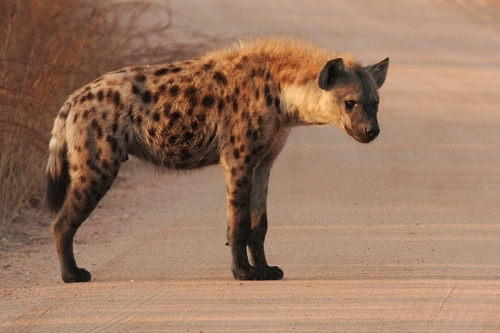
Spotted Hyena
Crocuta crocuta
Often misunderstood but undeniably brilliant, the Spotted Hyena is the savanna's most successful social predator. With a bite force that can crush bone and a matriarchal society that rivals primates in complexity, they are a highlight for any wildlife enthusiast's camera.
Quick Identification
Size
95-165 cm (37-65 in) long; 70-91 cm (28-36 in) at the shoulder; 40-86 kg (88-190 lbs)
Colors
Sandy or yellowish-grey coat covered in dark brown or black spots. Females are generally larger and more muscular than males.
Key Features
- Sloping back profile with front legs longer than back legs
- Rounded ears and a broad, blunt muzzle
- Coarse sandy coat with irregular dark spots
- Massive neck and powerful jaws built for bone-crushing
When You’ll See Them
Sightings on EverydayEarth
May 10, 2026
Three spotted hyaenas are active in a grassy clearing under the cover of night. Two individuals are clearly visible in the center of the frame, sniffing the ground and moving with their characteristic gait, while a third individual is positioned further to the left, primarily identifiable by its bright eyeshine.
Apr 15, 2026
A spotted hyena is seen moving through the dry vegetation at night. It pauses near the edge of a water source, lowering its head to sniff the ground before continuing its journey across the bushveld.
Behavior
Spotted Hyenas are famous for their complex social structures, living in large groups called clans that can number up to 80 individuals. Unlike most social mammals, these clans are strictly matriarchal, meaning the females are dominant, larger, and more aggressive than the males. They communicate through a wide array of vocalizations, most notably the 'whoop' call that can carry for miles and the famous 'laugh,' which is actually a high-pitched sound indicating social stress or excitement during a hunt or feeding frenzy.
While often unfairly portrayed as mere scavengers, Spotted Hyenas are actually highly skilled apex predators that hunt up to 95% of their own food. They are incredibly intelligent, with social intelligence that some researchers compare to primates. Their relationship with humans is complicated; while they generally avoid direct contact, they are highly adaptable and will venture near human settlements to scavenge or hunt livestock if natural prey is scarce, making them a common sight in the rural-urban interface across sub-Saharan Africa.
EverydayEarth exclusive
Camera Tips
To successfully capture a Spotted Hyena on camera, placement is everything. These animals are creatures of habit and frequently travel along established game trails, dry riverbeds, and dirt roads. Set your camera at 'hyena eye-level'—about 24 to 30 inches off the ground—and angle it slightly downward. This height is perfect for capturing the unique spot patterns on their flanks, which researchers actually use to identify individuals. Because they have a distinct sloping posture, a camera placed too high will often only capture their backs and miss their expressive faces.
Hyenas are notoriously curious and possess one of the strongest bite forces in the animal kingdom. If you are using a trail camera in an area where they are active, a heavy-duty security box or 'bear box' is non-negotiable. They have been known to chew on, pull down, or completely destroy cameras that aren't properly secured. Scent is a powerful motivator for them; while we advise against leaving large amounts of food, a small amount of a strong-smelling lure like fish oil or commercial predator bait applied to a nearby log can encourage them to stop and sniff, giving you a perfect, still shot instead of a blurry 'drive-by' photo.
For camera settings, prioritize a high shutter speed or 'Fast' trigger response. Hyenas move with a characteristic loping gait that can be surprisingly quick. If your camera allows for it, use 'Hybrid Mode' to capture both a high-resolution photo and a 15-second video clip. The video is especially valuable for hyenas, as it allows you to hear their vocalizations and observe their fascinating social body language. Since they are predominantly nocturnal, ensure your infrared (IR) flash is set to its maximum range, as hyenas often linger cautiously at the edge of clearings before approaching a trail.
Frequently Asked Questions
Record Spotted Hyena at your habitat
Connect a camera to start building your own species record — AI identifies every visitor automatically.