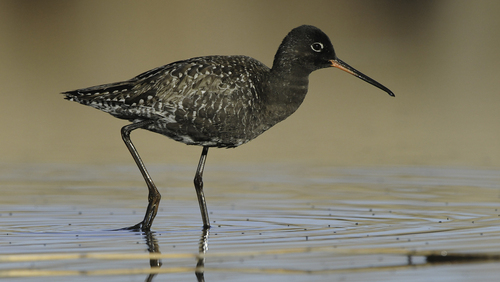
Spotted Redshank
Tringa erythropus
An elegant traveler of the wetlands, the Spotted Redshank is famous for its dramatic charcoal-black breeding plumage and striking crimson legs. Whether wading through saltmarshes or swimming in deep pools, this graceful shorebird is a master of the water's edge.
Quick Identification
Size
Length: 29–33 cm (11.5–13 in); Wingspan: 61–67 cm (24–26 in); Weight: 135–250 g (4.8–8.8 oz)
Colors
Breeding adults are nearly entirely soot-black with white speckles; winter adults are pale grey above and white below. Legs are always bright red.
Key Features
- Jet-black breeding plumage with fine white spotting
- Bright crimson-red legs that are longer than a Common Redshank's
- Long, needle-like bill with a slight down-curve at the tip
- Distinctive 'teu-it' dual-tone call
- White cigar-shaped wedge on the back visible in flight
When You’ll See Them
Behavior
The Spotted Redshank is often described as the more elegant, refined cousin of the Common Redshank. While many waders are frantic and noisy, this species moves with a graceful, deliberate gait. It is uniquely comfortable in deeper water, often wading up to its belly or even swimming—a behavior rarely seen in other shanks. When feeding in these deeper pools, it employs a rhythmic side-to-side sweeping motion with its bill to stir up aquatic prey.
During the non-breeding season, they are somewhat solitary or gather in small, loose groups rather than the massive, tight-knit flocks typical of other shorebirds. They are highly migratory, traveling vast distances from their Arctic breeding grounds to tropical wetlands. They are generally shy around humans and will take flight at the first sign of a direct approach, making remote camera monitoring the best way to observe their natural behavior without causing stress.
EverydayEarth exclusive
Camera Tips
To capture the Spotted Redshank on a trail camera, you must focus on the 'interface'—the exact line where shallow water meets soft mud. These birds rarely venture into tall vegetation, preferring open sightlines to spot predators. Place your camera on a low-profile ground stake or a stone, keeping the lens just 6 to 10 inches above the ground. This low angle not only provides an intimate perspective but also allows you to capture the bird's reflection in the water, which is particularly striking when they are in their dark breeding plumage.
Since you cannot use traditional birdseed to attract these insectivores, you have to 'bait' the environment. Look for areas of 'living mud'—places where midge larvae or small crustaceans are concentrated. If you have a backyard pond or a managed wetland area, creating a shallow 'scrape' (a flat, muddy depression) will naturally draw them in during migration. Ensure the area is free of tall reeds immediately around the camera, as Spotted Redshanks are wary of ambush spots and will avoid cluttered environments.
High trigger speeds are essential for waders. Even when they appear to be moving slowly, their stabbing beak movements and leg stretches are lightning-fast. Set your camera to 'Burst Mode' or 'Photo + Video' to ensure you catch the moment they reveal their identifying features, such as the white wedge on their back when they stretch their wings. Because they are most active during the transition of light at dawn and dusk, cameras with high-quality low-light sensors will perform significantly better than budget models.
Finally, consider the seasonality of your setup. In early spring, you might catch the dramatic transition from grey to charcoal black. By late summer, look for the 'dusky' juveniles who lack the bright red legs of the adults, sporting more orange-brown tones instead. Keep the camera housing well-camouflaged with local mud or dried grasses; although they aren't as clever as crows, these birds have sharp eyesight and may be deterred by a shiny plastic box sitting in the middle of an open mudflat.
Similar Species
Species that look similar or are commonly confused with Spotted Redshank.
Frequently Asked Questions
Record Spotted Redshank at your habitat
Connect a camera to start building your own species record — AI identifies every visitor automatically.