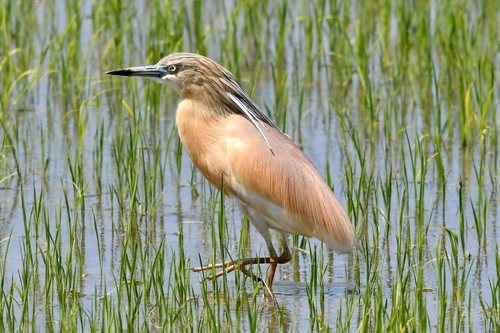
Squacco Heron
Ardeola ralloides
A secretive master of camouflage, the Squacco Heron is a golden-brown wetland dweller that reveals a flash of brilliant white when it takes to the sky.
Quick Identification
Size
Length 44–47 cm (17–18.5 in); Wingspan 80–92 cm (31–36 in); Weight 230–370 g (8–13 oz)
Colors
Sandy-buff or ochre body with stark white wings, tail, and belly; breeding adults have long, streaked head plumes; bill is blue-grey with a black tip
Key Features
- Stocky, short-necked profile when perched
- Brilliant white wings that appear suddenly during flight
- Long, drooping head plumes in breeding plumage
- Greenish-yellow legs that flush pink during courtship
When You’ll See Them
Behavior
The Squacco Heron is a master of the 'sit-and-wait' predatory style. Unlike more active hunters, this small heron often remains motionless for long periods, hunched among reeds or overhanging branches. Its buff-colored feathers provide incredible camouflage against dried marsh vegetation, making it nearly invisible until it suddenly strikes at prey with lightning speed.
While generally solitary hunters, they are surprisingly social during the nesting season, often joining mixed colonies of other heron species. They are less wary of humans than larger herons but will usually freeze or slowly retreat into cover rather than taking flight immediately. When they do fly, the transformation is startling: the cryptic brown bird suddenly reveals large, snowy-white wings, making it look like an entirely different species.
EverydayEarth exclusive
Camera Tips
To capture high-quality footage of a Squacco Heron, placement is everything. These birds prefer the 'edge zone'—where water meets dense vegetation. Position your camera just 12–18 inches above the ground or water level, aimed at a clear opening in the reeds or a low-hanging branch over a shallow pool. A low angle not only creates a more intimate, professional-looking shot but also ensures you catch their striking reflection in the water.
Because Squacco Herons are famous for their sudden 'strike,' camera trigger speed is critical. Set your AI camera to its fastest trigger mode or use a high-frame-rate video setting (at least 60fps) if your hardware supports it. This allows you to capture the precise moment the heron extends its neck to snag a fish, which happens in a fraction of a second. If your camera allows for 'Pre-roll' or 'Pre-capture,' enable it to ensure you don't miss the start of the action.
Lighting can be a challenge because of the bird's high-contrast colors. Their white wings can easily 'blow out' and lose detail in harsh midday sun. Aim to position your camera so the sun is at its back during the early morning or late afternoon (golden hour). This provides a soft, warm glow on their buff-colored backs and prevents the white feathers from appearing as a featureless blur when they move.
Avoid using artificial lures or bait, as these birds respond best to a healthy, natural ecosystem. Instead, look for 'hot spots' where small fish or frogs congregate. If you have a backyard pond, ensuring you have a shallow 'beach' area or a partially submerged log will significantly increase your chances of a Squacco Heron stopping by for a photo op. They are creatures of habit; if they find a productive hunting spot, they will likely return to it daily.
Similar Species
Species that look similar or are commonly confused with Squacco Heron.
Frequently Asked Questions
Record Squacco Heron at your habitat
Connect a camera to start building your own species record — AI identifies every visitor automatically.