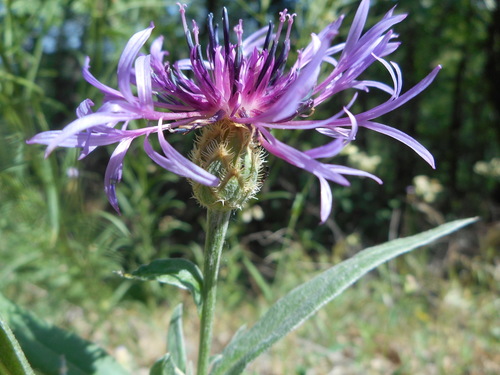
squarrose knapweed
Centaurea triumfettii
A gem of the alpine meadows, the squarrose knapweed dazzles with its silver-tinted leaves and electric blue sunburst blooms. It is a vital nectar source and a favorite subject for backyard naturalists and macro photographers.
Quick Identification
Size
Stands 30–60 cm (12–24 inches) tall; flower heads typically measure 3–5 cm (1.2–2 inches) in diameter.
Colors
Brilliant violet-blue or azure-blue outer ray florets; inner disc florets are typically deep reddish-purple or violet; foliage is a distinctive silver-greyish green.
Key Features
- Deep blue-to-purple ray florets with a darker central hub
- Silver-grey, lance-shaped leaves with fine, woolly hairs
- Stems feature narrow 'wings' where leaf bases extend downward
- Flower bracts have dark, comb-like (pectinate) fringes at the tips.
When You’ll See Them
Geographic range
Where Does the squarrose knapweed Live?
The squarrose knapweed is primarily native to the mountainous regions of Central and Southern Europe, with its core range extending from the Pyrenees and the Alps across to the Balkan Peninsula and the Caucasus. It is a common sight in the higher elevations of Italy, France, Austria, and Turkey. While it has been introduced to parts of North America and Northern Europe as a garden ornamental, it remains localized and is not considered a widespread invasive like some of its congeners.
Basemap © OpenStreetMap contributors
Behavior
Squarrose knapweed is a hardy perennial that thrives in the sun-drenched, well-drained soils of mountain meadows and rocky slopes. Unlike some of its more aggressive relatives, Centaurea triumfettii is often valued for its ornamental beauty and its role in supporting local biodiversity. It spends the early spring forming a basal rosette of silvery leaves before sending up flowering stems as the weather warms.
During its blooming period, the plant exhibits a fascinating relationship with sunlight and pollinators. The flower heads open fully in response to morning light to maximize visibility for bees and butterflies. It is a high-nectar species, often acting as a social hub for insects in alpine and subalpine environments, where it competes for the attention of pollinators with its vivid, star-burst-like petals.
EverydayEarth exclusive
Camera Tips
Capturing the squarrose knapweed on an AI camera requires a focus on micro-movements. Since the plant itself is stationary, place your camera on a low-profile ground mount or a short tripod about 12 to 20 inches from the flower head. This positioning allows the camera's AI to trigger not just on the plant, but on the frequent insect visitors like bumblebees, fritillary butterflies, and hoverflies that are drawn to its nectar.
Lighting is crucial for this species due to its silver-grey foliage, which can easily wash out in harsh midday sun. Set your camera to capture images during the 'golden hours' of early morning or late afternoon. The blue pigments of the petals are most saturated under soft, natural light, which prevents the highlights on the woolly leaves from becoming overexposed. If your camera has a macro mode or adjustable focal range, use it to highlight the intricate comb-like fringes on the bracts beneath the flower.
Because knapweed sways significantly in the mountain breeze, use a fast shutter speed setting if your camera allows it. This prevents motion blur and ensures that both the flower and its pollinators are crisp. If you are monitoring a specific patch over the season, time-lapse settings are an excellent way to record the transition from the silver-leafed rosette stage to the dramatic purple-blue eruption of the blooms in early summer.
Frequently Asked Questions
Record squarrose knapweed at your habitat
Connect a camera to start building your own species record — AI identifies every visitor automatically.