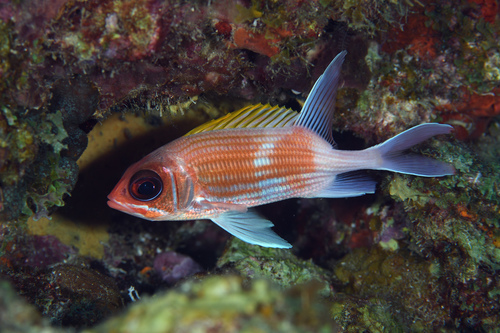
Squirrelfish
Holocentrus adscensionis
Meet the Squirrelfish, the wide-eyed night watchman of the Atlantic reefs. Known for their brilliant red scales and the ability to 'speak' through clicks and grunts, these fascinating fish are a favorite for underwater camera enthusiasts.
Quick Identification
Size
Typically 25–35 cm (10–14 inches), reaching a maximum length of 60 cm (24 inches) and weighing up to 1.5 kg (3.3 lbs).
Colors
Bright reddish-orange to gold upper body with horizontal silvery streaks; white or pale underside; yellowish tints on the spiny dorsal fin.
Key Features
- Large, dark 'squirrel-like' eyes adapted for night vision
- Vibrant reddish-gold body with pale horizontal stripes
- Sharp, prominent spines on the dorsal fin and gill covers
- Deeply forked caudal tail with elongated upper and lower lobes
When You’ll See Them
Geographic range
Where Does the Squirrelfish Live?
The Squirrelfish is a widespread resident of the warm Atlantic Ocean waters, ranging from the coast of North Carolina and Bermuda down through the Caribbean and Gulf of Mexico to the shores of Brazil. On the eastern side of the Atlantic, it thrives from Gabon to the volcanic cliffs of Ascension Island. Interestingly, this species has recently expanded its reach into the Mediterranean Sea, with confirmed sightings near Malta and Northern Cyprus, likely arriving through the Suez Canal or ship ballast water.
Basemap © OpenStreetMap contributors
Behavior
Squirrelfish are classic nocturnal reef dwellers that spend the majority of their daylight hours hidden deep within the shadows of coral crevices, caves, and rocky overhangs. They are highly territorial about their daytime shelters and can often be seen hovering motionless just inside the mouth of a cave, peering out with their oversized eyes. Despite their solitary nature during the day, they may congregate in loose groups under large ledges, though they maintain individual space.
What truly sets the Squirrelfish apart is its 'talkative' nature. These fish are known to produce audible clicking, grunting, and staccato sounds by vibrating their swim bladders with specialized muscles. These vocalizations are used primarily for territorial defense and to warn other fish of approaching predators. At night, they become much bolder, leaving the safety of the reef to forage over nearby sandy bottoms and seagrass beds.
EverydayEarth exclusive
Camera Tips
To capture high-quality footage of Squirrelfish, you must think like a nocturnal explorer. Since these fish are light-shy during the day, position your underwater camera near 'real estate'—look for dark holes in limestone rock, underside of dock pilings, or coral crevices. Mounting your camera on a weighted tripod or a fixed dock mount facing a known crevice is the most effective way to see them in their natural state. During the day, they will likely just be 'peeking' out, but as dusk falls, you can catch them transitioning into their active hunting mode.
Lighting is the biggest challenge when filming Squirrelfish. Their large eyes are extremely sensitive to light; a powerful white floodlight will cause them to retreat immediately and may disrupt their natural behavior. For the best results, use infrared (IR) illumination or a red light filter. Most fish, including Squirrelfish, cannot see red light well, allowing you to observe their nighttime foraging without scaring them off. If you are using a trigger-based system, set it to record short bursts of video (15-30 seconds) rather than long segments to conserve battery in cooler underwater temperatures.
If you are setting up a camera in a backyard marine environment, such as a canal or under a private dock, focus on the structural supports. Squirrelfish love man-made structures because they provide ample hiding spots. You can lightly 'chum' the area with crushed shrimp or crab shells just before sunset to encourage them to spend more time in front of the lens, but the best strategy is simply finding the specific hole they call home. Because they are vocal, if your camera has an underwater microphone (hydrophone), you might even capture their unique grunting and clicking sounds as they defend their spot from intruders.
Similar Species
Species that look similar or are commonly confused with Squirrelfish.
Frequently Asked Questions
Record Squirrelfish at your habitat
Connect a camera to start building your own species record — AI identifies every visitor automatically.