Sri Lankan Giant Squirrel
Ratufa macroura
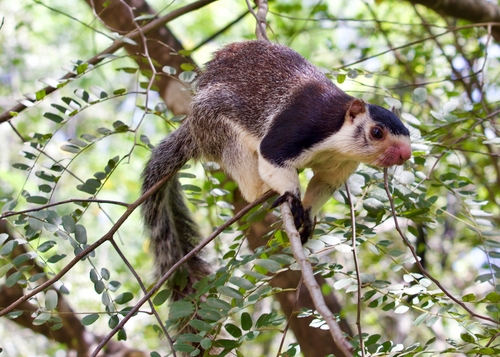
Known as the 'Grizzled Giant,' this master of the canopy is one of the largest squirrels in the world. With its salt-and-pepper coat and incredible leaping power, it is a spectacular sight for anyone lucky enough to spot it in the highlands of Sri Lanka or the river forests of Southern India.
Quick Identification
Size
Head-to-body length of 25–45 cm (10–18 in) with a tail of 25–50 cm (10–20 in); weighs between 1.5–3 kg (3.3–6.6 lbs)
Colors
Grizzled grey to brownish-black upperparts with a white or creamy-yellow underbelly and a dark, bushy tail
Key Features
- Grizzled 'salt and pepper' fur texture
- Exceptionally long, bushy tail
- Large size compared to garden squirrels
- Small, rounded ears with short tufts
When You’ll See Them
Geographic range
Where Does the Sri Lankan Giant Squirrel Live?
This magnificent giant squirrel is native to the island of Sri Lanka and parts of Southern India. It is primarily found in the highland forests of the Central and Uva provinces of Sri Lanka. In India, its range is more restricted, occurring in isolated patches of riparian forest along the Kaveri River and within the hill forests of Karnataka, Tamil Nadu, and Kerala. It is a specialist of mature forests and rarely ventures far from established riverine corridors or high-canopy environments.
Basemap © OpenStreetMap contributors
Behavior
The Sri Lankan Giant Squirrel is an arboreal acrobat, spending nearly its entire life in the high canopy. These squirrels are primarily solitary and highly territorial, marking their domain within the treetops. They are known for their incredible leaping ability, capable of jumping up to 6 meters between branches to escape predators or reach a fresh food source. When they sense danger, they have a unique habit of freezing and flattening their bodies against a branch, using their grizzled fur to blend perfectly with the bark.
While shy and wary of humans, they are remarkably vocal. Their presence is often detected by a loud, rattling 'staccato' call that echoes through the forest. In home gardens adjacent to forest patches, they may become semi-habituated to human presence, provided there are tall fruit trees like mango or jackfruit to keep them safely above the ground. They are most active in the early morning and late afternoon, retreating to leaf-lined nests, or 'dreys,' during the midday heat.
EverydayEarth exclusive
Camera Tips
To successfully capture a Sri Lankan Giant Squirrel on camera, you must think vertically. These mammals rarely touch the forest floor, so mounting your camera at eye level will likely only net you images of ground-dwelling species. Instead, use a ladder or a climbing strap to secure your camera 10 to 15 feet up a sturdy tree trunk. Look for 'highways'—thick horizontal branches that connect different parts of the canopy—as these are the squirrel's primary travel routes.
Lighting is a major challenge in the canopy. The high contrast between bright sky and dark foliage can wash out your images. Position your camera so it is not facing directly into the morning or evening sun. Since these squirrels move with sudden, jerky movements and long leaps, use a camera with a fast trigger speed (under 0.3 seconds) and set it to take a 'burst' of 3-5 photos. This increases your chances of getting a clear shot of the squirrel in motion rather than just a blurry tail.
While we don't recommend traditional baiting, you can increase your odds by placing cameras near ripening fruit. If you have a fruiting tree in your yard, such as a mango or tamarind, focus your camera on a branch leading toward the fruit clusters. Ensure the camera's PIR (motion) sensitivity is set to 'high' because, despite their size, their movement high up in the breeze-blown branches can sometimes be missed by less sensitive sensors.
Similar Species
Species that look similar or are commonly confused with Sri Lankan Giant Squirrel.
Frequently Asked Questions
Record Sri Lankan Giant Squirrel at your habitat
Connect a camera to start building your own species record — AI identifies every visitor automatically.