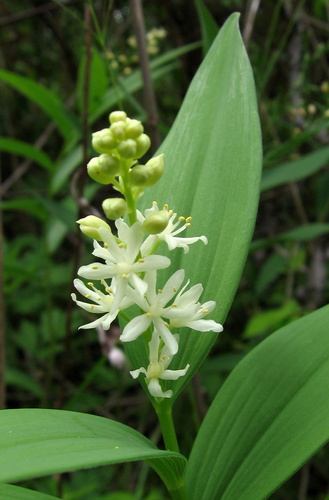
star-flowered lily-of-the-valley
Maianthemum stellatum
A woodland gem with a rhythmic zig-zag stem and starry white blooms, the star-flowered lily-of-the-valley brings a sophisticated, native elegance to shaded backyards. Watch its fascinating transition from striped green berries to ruby-red treats for local songbirds.
Quick Identification
Size
Height ranges from 8 to 24 inches (20–60 cm); leaves are 2 to 6 inches (5–15 cm) long.
Colors
Creamy white flowers; bright green foliage; berries transition from green with dark blackish stripes to a deep, translucent ruby red.
Key Features
- Distinctive zig-zagging arching stem
- Terminal cluster of 5-15 small, star-shaped white flowers
- Alternate, lance-shaped leaves that slightly clasp the stem
- Berries featuring dark longitudinal stripes before ripening to red
When You’ll See Them
Behavior
The star-flowered lily-of-the-valley, also known as Starry False Solomon's Seal, is a graceful perennial that spreads via underground rhizomes. Unlike many aggressive garden plants, it forms polite, loose colonies that dance in the dappled light of the forest floor. It emerges early in the spring, its leaves tightly furled like small green spears before expanding into their characteristic alternating pattern along a subtly winding stem.
As an ecological contributor, this plant plays a vital role in the mid-summer garden. Once its delicate starry blooms fade, it develops unique striped berries that are a magnet for woodland residents. While it appears delicate, it is remarkably resilient, capable of surviving in various soil types and providing a reliable seasonal clock for backyard observers as it transitions from its 'flowering' phase to its 'fruiting' phase in late summer.
EverydayEarth exclusive
Camera Tips
To capture the stunning transformation of the star-flowered lily-of-the-valley, you should position your camera at a 'toad’s eye view.' Set your device on a low tripod or ground mount only 10 to 12 inches above the soil. This perspective allows you to look up into the delicate, star-shaped blossoms and catch the light filtering through the leaves, which makes the plant's architecture really pop on screen.
Because this species is a stationary target, the best way to utilize an AI camera is to focus on its visitors. Set your motion sensitivity to high to capture the native bees and flies that navigate the white flowers in May. In the late summer, refocus your lens on the berry clusters. The transition of the berries from green-and-black striped to solid red is a slow-motion drama that is best captured using a Time Lapse setting, taking one photo every 6 to 12 hours over a period of two weeks.
Lighting is critical for this species. If your camera is placed in a deep shade area, try to angle it so it catches 'sun flecks'—the moving spots of light that break through the tree canopy. This natural spotlighting creates a professional look without the need for a harsh flash, which can often overexpose the white petals of the flower. If your camera supports it, use a macro or close-focus mode to capture the intricate details of the six-pointed blooms.
To see the most animal interaction, keep the area around your star-flowered lily-of-the-valley natural. Do not clear away the leaf litter, as ground-dwelling birds like Spotted Towhees or Hermit Thrushes will often kick through the leaves near the base of the plant before jumping up to snag a ripe red berry. If you have a trail camera with a video mode, set it to 15-second clips to record the delicate way these birds harvest the fruit without damaging the arching stems.
Frequently Asked Questions
Record star-flowered lily-of-the-valley at your habitat
Connect a camera to start building your own species record — AI identifies every visitor automatically.