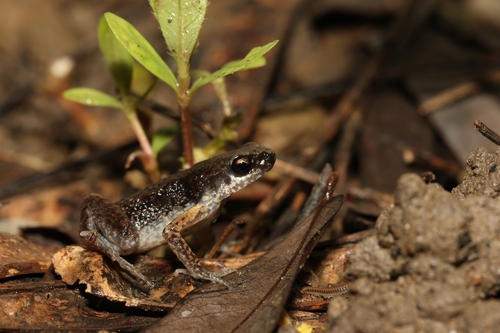
Stejneger's Paddy Frog
Micryletta steinegeri
Hidden among the fallen leaves of Taiwan's southern forests, Stejneger's Paddy Frog is a miniature marvel of camouflage and secret marbled beauty.
Quick Identification
Size
Small and slender; 2–3 cm (0.8–1.2 inches) in length; weighs only a few grams
Colors
Dull greyish-brown to reddish-brown on the back, often with a dark 'X' or 'H' shaped mark; the belly is a striking contrast of dark brown or black with white or yellowish marbling
Key Features
- Small, narrow-mouthed profile
- Striking black and white marbled belly pattern
- Faint dark 'X' mark on the shoulders
- Long, slender limbs relative to body size
When You’ll See Them
Behavior
Stejneger's Paddy Frog is a highly secretive, terrestrial species that spends most of its life hidden within the humid layers of leaf litter. Unlike more boisterous pond frogs, this species relies on its incredible camouflage to remain undetected by predators. They are primarily solitary, only congregating in small numbers during the peak of the rainy season when breeding calls can be heard from the forest floor.
Their movement is characterized by short, quick hops rather than long leaps. When threatened, they often remain perfectly still, trusting their earthy dorsal tones to blend into the soil and dead leaves. They are not particularly bold around humans and will quickly retreat into crevices or under logs if they sense vibration or movement.
EverydayEarth exclusive
Camera Tips
To capture the Stejneger's Paddy Frog, camera placement is everything. Because these frogs rarely exceed an inch in length, you must mount your camera at ground level. Aim the lens at a slight downward angle toward a patch of moist leaf litter or the edge of a shallow, stagnant puddle. Using a camera with a close-focusing distance or a macro lens attachment is highly recommended to ensure the frog's fine skin textures are sharp.
Since these frogs are strictly nocturnal and most active during the monsoon rains, look for 'splash zones'—areas where rainwater naturally collects or drips from overhanging leaves. The AI on your camera should be set to high sensitivity for small animals. If your camera supports it, set it to trigger short 10-second video clips. The movement of a frog hopping is often easier for the sensor to detect than a stationary frog blending into the leaves.
While you can't bait these frogs with food like you would a bird, you can 'lure' them by creating the perfect micro-habitat. A shallow saucer of water buried flush with the ground, surrounded by damp moss and decaying leaves, creates an irresistible stage for them. Ensure your camera uses No-Glow infrared flash; standard white flashes may cause the frog to freeze or retreat, and the high-contrast marbled belly pattern can easily be overexposed and 'blown out' by bright lights.
Frequently Asked Questions
Record Stejneger's Paddy Frog at your habitat
Connect a camera to start building your own species record — AI identifies every visitor automatically.