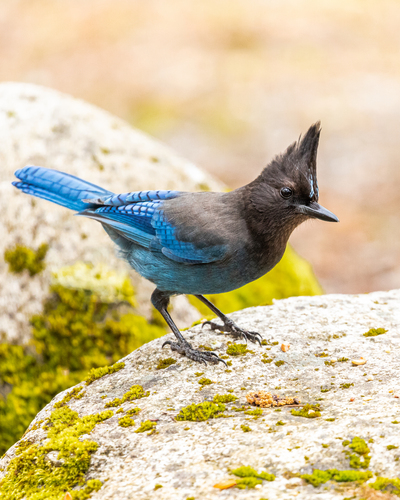
Steller's Jay
Cyanocitta stelleri
Meet the bold, blue-blooded intelligence of the Western woods. With their striking charcoal crests and clever personalities, Steller’s Jays are the charismatic stars of any backyard camera setup.
Quick Identification
Size
Length: 11.8–13.4 in (30–34 cm); Wingspan: 17.3 in (44 cm); Weight: 3.5–4.9 oz (100–140 g)
Colors
Deep charcoal-black head, neck, and upper back; vibrant cerulean blue wings, tail, and underparts. Subtle light blue streaks on the forehead.
Key Features
- Prominent triangular charcoal crest
- Deep blue body with contrasting blackish head
- Large, sturdy black bill
- Bold, inquisitive personality and loud, harsh calls
When You’ll See Them
Sightings on EverydayEarth
Jul 19, 2026
A Steller's Jay enters from the lower-left corner and hops across the dry, scrubby terrain. It pauses briefly to forage on the ground near a large mammal carcass before continuing its path. The scene is quiet with bright morning light casting long shadows.
Jul 13, 2026
Two Steller's Jays are foraging on the dry, grassy ground. They hop around for several seconds before both fly off-screen to the left.
Jul 10, 2026
A group of scavengers, including Turkey Vultures and Common Ravens, are gathered on a dry, grassy hillside near an enclosure. As the camera pans to the left, a Steller's Jay is seen foraging near the fence line while a Turkey Vulture remains visible in the foreground.
Jul 4, 2026
A Steller's Jay perches on the edge of a rocky water basin, looking around alertly. It displays typical cautious behavior, scanning the dry, grassy hillside before hopping slightly to adjust its position on the rock.

Jun 11, 2026
A Steller's Jay is perched among the green shrubs in the foreground, overlooking the sweeping vista of Lake McDonald and the surrounding mountains under a cloudy sky.

Jun 11, 2026
A Steller's Jay is perched in the center foreground among the green mountain shrubs. The bird is oriented toward the distant mountains, showcasing its dark crest and vibrant blue lower plumage against the lush vegetation.
Behavior
Steller's Jays are the brilliant, boisterous sentinels of the Western forests. Highly intelligent and social, they often travel in pairs or family groups and are known for their remarkable vocal range. They are master mimics, frequently imitating the screams of Red-tailed Hawks to clear other birds away from a food source or mimicking mechanical sounds they hear in suburban environments.
In a backyard setting, these jays are bold and opportunistic. They are famous for 'caching'—storing excess food in various locations to retrieve during the winter. While they can be dominant at feeders, their complex social interactions and playful curiosity make them one of the most entertaining species to observe on a high-definition wildlife camera.
EverydayEarth exclusive
Camera Tips
To capture the best footage of Steller's Jays, focus on stability and accessibility. Because these are relatively large, heavy birds, they prefer flat platform feeders or wide, sturdy branches over small, swinging tube feeders. Mount your camera 5 to 6 feet off the ground, angled slightly downward toward a flat surface where the jay can land comfortably. Their deep blue and charcoal coloring can be tricky for camera sensors; try to place your setup in an area with bright, indirect light or filtered morning sun to avoid losing the detail of their dark heads in heavy shadows.
Peanuts are the 'gold standard' lure for Steller's Jays. Placing whole, unsalted peanuts in the shell on a tray will trigger fascinating behavior sequences. You’ll often capture them 'weight-testing' the nuts—picking up several different peanuts to find the heaviest one before flying off. To keep them in the frame longer for a better video, try using a suet cage or a log with holes drilled into it filled with nut butter. This forces the jay to stay and work at the food rather than the typical 'grab-and-go' strategy.
In terms of camera settings, use a high-sensitivity trigger. Steller's Jays are fast and prone to sudden, jerky movements. If your camera allows for it, a higher frame rate (60fps) is ideal for capturing the subtle movements of their crest and the iridescent shimmer of their wing feathers. If you are using an AI-powered camera, ensure the 'Bird' detection is prioritized, as their large size and distinct silhouette make them easy for most algorithms to identify even from a distance.
Similar Species
Species that look similar or are commonly confused with Steller's Jay.
Frequently Asked Questions
Record Steller's Jay at your habitat
Connect a camera to start building your own species record — AI identifies every visitor automatically.