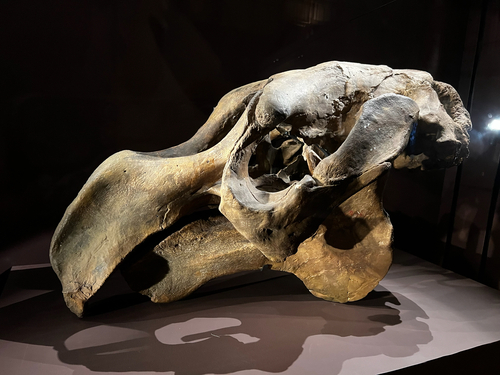
Steller's Sea Cow
Hydrodamalis gigas
The Steller's Sea Cow was a gentle, 10-ton titan of the North Pacific that lived in the heart of the world's most kelp-rich waters. Though it vanished just 27 years after its discovery, it remains one of the most fascinating examples of megafauna to have ever graced our coastlines.
Quick Identification
Size
Length of 8–9 metres (26–30 feet); weight estimated between 8–10 metric tons (17,600–22,000 lbs)
Colors
Dark brown to blackish skin, often described as resembling the bark of an old tree; occasionally featured light patches or white streaks from scarring
Key Features
- Massive spindle-shaped body with a relatively small head
- Thick, craggy, bark-like skin used for protection against ice and rocks
- Forked tail fluke similar to that of a whale or dolphin
- Short, stump-like forelimbs used for walking along the sea floor
When You’ll See Them
Geographic range
Where Does the Steller's Sea Cow Live?
This species was native to the North Pacific Ocean, with a prehistoric range that likely spanned from the coasts of Japan across the Aleutian Islands to California. By the time it was scientifically described in the mid-18th century, its population had been restricted to the remote, icy waters surrounding the Commander Islands in the Bering Sea. This final refuge represented a tiny fraction of its former territory, making the species highly vulnerable to the sudden pressure of European fur-trading expeditions.
Basemap © OpenStreetMap contributors
Behavior
These sirenians were constant grazers, moving slowly through kelp forests and using their powerful, toothless mouths to tear at marine vegetation. They were known to be very tame and showed little fear of humans or boats. Because they lacked the ability to dive, they were frequently seen with their backs exposed above the water, appearing like dark, floating islands to early explorers. They were also observed to be monogamous, with pairs often staying close together regardless of the herd's movement.
EverydayEarth exclusive
Camera Tips
To capture a creature of this scale in its historical habitat, your camera placement would need to be strategically positioned along the rocky intertidal zones where kelp is most abundant. Because the Steller's Sea Cow could not submerge, a shore-mounted camera on a high tripod or a cliff-edge looking down at a 45-degree angle would be ideal. This perspective ensures you capture the massive, 30-foot profile of the animal without the distortion of the water's surface, particularly during low tide when they would congregate in the shallowest channels to feed.
For those using AI-powered triggers, you would need to set a wide detection zone. A sea cow's movement is slow and rhythmic, so a standard motion sensor might mistake it for a floating log. Using a camera with time-lapse capabilities set to 30-second intervals is a safer bet to document their grazing patterns. Since they inhabited the frigid Bering Sea, high-quality infrared (IR) sensors are mandatory to penetrate the frequent heavy fogs and maritime mist that would otherwise obscure the lens during their active night-time feeding sessions.
Baiting would involve finding a sheltered cove where giant kelp (Nereocystis) naturally drifts and accumulates. Steller noted that these animals were particularly fond of freshwater; placing your camera gear near a river mouth or a spot where freshwater streams flow into the sea would significantly increase your chances of a close-up encounter. The animals often gathered in these areas to rest or drink, providing a predictable location for consistent monitoring. Ensure your equipment is housed in a rugged, waterproof, and salt-resistant casing to withstand the harsh, corrosive sub-arctic environment.
Similar Species
Species that look similar or are commonly confused with Steller's Sea Cow.
Frequently Asked Questions
Record Steller's Sea Cow at your habitat
Connect a camera to start building your own species record — AI identifies every visitor automatically.