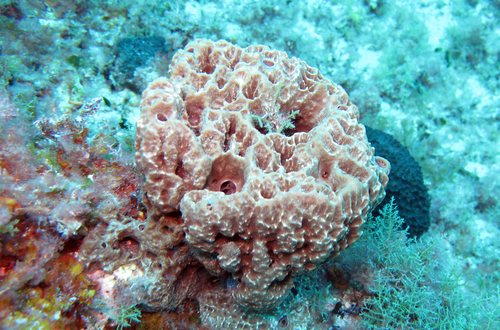
Stinker Sponge
Sarcotragus fasciculatus
A hardy survivor of the Mediterranean seabed, the Stinker Sponge is a master of chemical defense and a vital filter for our coastal waters. Though it lacks movement, its complex structure provides a fascinating miniature skyscraper for tiny marine creatures.
Quick Identification
Size
Typically 10–25 cm (4–10 inches) in diameter, though large specimens can reach up to 40 cm (16 inches) in height.
Colors
Exterior ranges from dark brown to deep black or charcoal grey; the interior tissue is typically a lighter tan or yellowish-cream.
Key Features
- Massive, lobated, or globular growth form
- Tough, leathery surface covered in small conical protrusions (conules)
- Large, distinct exhalant openings (oscula) concentrated on the upper surface
When You’ll See Them
Geographic range
Where Does the Stinker Sponge Live?
Native to the Mediterranean Sea and the eastern Atlantic Ocean, the Stinker Sponge is a staple of southern European and North African marine ecosystems. It is most commonly found along the rocky coastlines of Italy, Greece, Spain, and Croatia, with significant populations also residing in the warmer waters off the coasts of Turkey and Tunisia. While primarily a Mediterranean species, its range extends slightly into the adjacent Atlantic waters near the Strait of Gibraltar.
Basemap © OpenStreetMap contributors
Behavior
The Stinker Sponge is a sessile marine invertebrate that leads a sedentary life permanently attached to rocky substrates. Unlike more active marine life, its behavior is defined by its sophisticated water-pumping system. It constantly draws seawater through thousands of tiny pores (ostia), filters out nutrients, and expels the processed water through larger openings called oscula. This continuous filtration is vital for the health of the surrounding reef ecosystem, as it cycles nutrients and clarifies the water.
As its name suggests, this species is famous for the pungent, unpleasant odor it emits when removed from the water, a result of complex chemical compounds. These chemicals, including fasciculatin, serve a biological purpose beyond just smelling bad; they act as a potent defense mechanism against predatory fish and prevent other organisms, like algae or barnacles, from growing on the sponge's surface. While it does not interact with humans directly, it is often seen by divers and monitored by coastal observers as an indicator of marine water quality.
EverydayEarth exclusive
Camera Tips
Capturing the Stinker Sponge requires a waterproof underwater camera housing or a specialized marine trail camera. Since this species is sessile (non-moving), focus on placement and lighting rather than motion triggers. Position your camera on a stable, rocky outcrop roughly 1 to 2 meters away from the sponge to capture its full structure and any visiting marine life. Using a weighted tripod or a strap-mount fixed to a heavy rock will prevent the camera from shifting with the tide or currents.
Lighting is the biggest challenge for underwater photography. At depths below 5 meters, red light is absorbed by the water, making everything look blue or green. If your camera setup allows, use a wide-angle lens and external underwater lights (strobes or constant video lights) to reveal the true dark brown or black coloration of the sponge. Early morning or midday sun provides the best natural ambient light if the water is clear.
Set your camera to take time-lapse photos or short video clips at regular intervals rather than relying on motion detection, which can be falsely triggered by floating debris or seagrass. This strategy allows you to observe the sponge's oscula (pores) and the small crustaceans or fish that often use the sponge as a hiding spot. Check your lens for algae growth or silt buildup every few days if you are doing a long-term deployment.
Frequently Asked Questions
Record Stinker Sponge at your habitat
Connect a camera to start building your own species record — AI identifies every visitor automatically.