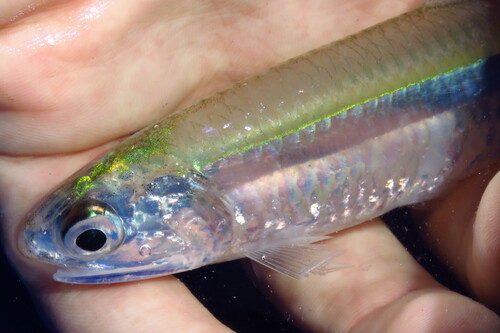
Striped Anchovy
Anchoa hepsetus
A shimmering marvel of the Atlantic coast, the Striped Anchovy is the engine of the ocean's food web. Recognized by its brilliant silver racing stripe, this small but mighty fish turns coastal waters into a flash of living light.
Quick Identification
Size
Typically reaches 10-15 cm (4-6 inches) in length
Colors
Translucent grey-green upper body with fine black speckling; a prominent, wide silvery stripe runs along the side from head to tail; iridescent white or silver belly
Key Features
- Prominent broad silver lateral stripe
- Large mouth with a distinctive underslung lower jaw
- Pointed snout that overhangs the mouth
- Elongated, streamlined body shape
- Anal fin begins directly under the end of the dorsal fin
When You’ll See Them
Behavior
Striped Anchovies are highly social, schooling fish that move in tight, shimmering formations. This schooling behavior serves as a primary defense mechanism, creating a 'silver flash' effect that confuses predators like bluefish, seatrout, and coastal birds. They are predominantly found in shallow coastal waters, estuaries, and bays, where they move with the tides to follow concentrations of plankton.
Unlike many other fish species, Striped Anchovies are relatively short-lived and fast-growing, reaching maturity quickly to support their massive population numbers. They are most active during the day when they can see their tiny prey, though they may move toward the surface or into brighter areas of the dock at night if artificial lights are present.
EverydayEarth exclusive
Camera Tips
Capturing the Striped Anchovy requires a waterproof action camera or a dedicated underwater trail camera system. For those with waterfront property, the best results are achieved by mounting the camera to a dock piling or pier leg about 2 to 4 feet below the low-tide line. Angle the lens slightly upward toward the surface to capture the shimmering effect of sunlight hitting their silver lateral stripes, which makes them pop against the darker water.
To attract a school into the camera's field of view, consider using a 'chum' bag filled with finely ground fish meal or breadcrumbs, but the most effective 'lure' for these fish is often a underwater light. A green or white LED submersible light placed near the camera at night will attract the zooplankton that anchovies feed on, often bringing hundreds of fish directly in front of your lens in a swirling bait ball.
Because these fish move exceptionally fast, set your camera to a high frame rate (at least 60fps) to avoid motion blur. If your camera has a 'burst' mode for stills, use it to capture the perfect moment when the school turns in unison. Clear water is essential for good footage, so try to time your recording for an hour after high tide when the incoming ocean water has settled and visibility is at its peak.
In a backyard setting with a salt marsh or tidal creek, you can also use a weighted 'tripod' rig set on the sandy bottom. Ensure the camera is stable, as tidal currents can cause vibration that will spook the school. Spring is the best time for high-activity footage, as this is when they migrate into shallower waters in massive numbers to spawn.
Similar Species
Species that look similar or are commonly confused with Striped Anchovy.
Frequently Asked Questions
Record Striped Anchovy at your habitat
Connect a camera to start building your own species record — AI identifies every visitor automatically.