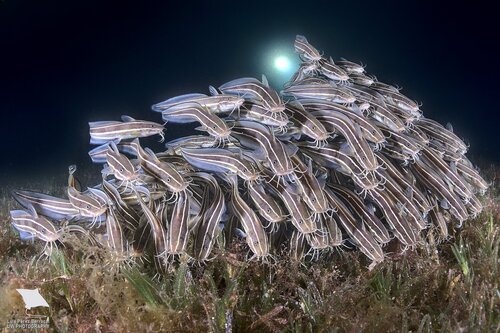
Striped Eel Catfish
Plotosus lineatus
The Striped Eel Catfish is a striking marine navigator known for its mesmerizing schooling 'balls' and bold, longitudinal racing stripes. A fascinating addition to any coastal camera setup, these fish blend social intelligence with a powerful venomous defense.
Quick Identification
Size
Maximum length of 32 cm (12.6 inches); common size is 15-20 cm (6-8 inches).
Colors
Dark brown to black body with two or three prominent white or yellowish longitudinal stripes; belly is typically pale or white.
Key Features
- Four pairs of sensory barbels around the mouth
- Continuous eel-like tail fin that merges with the dorsal and anal fins
- Highly venomous serrated spines on the dorsal and pectoral fins
When You’ll See Them
Behavior
The Striped Eel Catfish is one of the most social fish species found in coastal environments. Juveniles are famous for forming dense, ball-like schools that can contain hundreds of individuals. This 'rolling' school moves across the seafloor as a single unit, a defensive strategy designed to confuse predators and mimic a much larger organism. As the fish grow older, they become less gregarious, with adults typically found in smaller groups or living a more solitary existence sheltered under ledges or in crevices.
While they appear gentle as they sift through the sand, they possess a formidable defense mechanism. The first ray of their dorsal and pectoral fins is a sharp, serrated spine connected to venom glands. While not aggressive toward humans, their sting is extremely painful and can cause significant swelling or even more serious systemic reactions. They are benthic dwellers, meaning they are almost always found in contact with or very close to the substrate.
EverydayEarth exclusive
Camera Tips
Capturing the Striped Eel Catfish requires a specialized underwater camera setup or an action camera in a waterproof housing. To record the iconic 'schooling ball' behavior of the juveniles, place your camera on a weighted tripod or a flat rock in shallow water (1-3 feet deep) near a sandy patch adjacent to a reef or dock. Position the lens at a low angle, roughly 4-6 inches above the seabed, to capture the fish as they forage and roll across the bottom.
Because these fish are highly sensitive to movement and vibrations, it is best to use a remote-trigger or a camera with an AI-detection feature that records when motion is detected. If your 'backyard' is a dock or a canal-front property, lowering a camera tethered to a pole during the mid-morning hours when the sun is high will provide the best natural light for identifying their distinctive white stripes.
Avoid using heavy artificial lighting during the day as it can wash out the contrast of their stripes. However, if you are targeting the larger, more solitary adults at night, a light with a red filter is recommended to observe their natural scavenging behavior without startling them. Ensure your camera housing is cleaned of algae regularly, as the fine sand kicked up by these catfish can settle on the lens and ruin the clarity of your footage.
For the most engaging shots, look for areas with 'biogenic' activity—places where other animals are digging or where the tide is turning. The Striped Eel Catfish are opportunists and will often swarm an area where the substrate has been recently disturbed. High-frame-rate settings (60fps or higher) are ideal for capturing the fluid, undulating motion of their eel-like tails.
Frequently Asked Questions
Record Striped Eel Catfish at your habitat
Connect a camera to start building your own species record — AI identifies every visitor automatically.