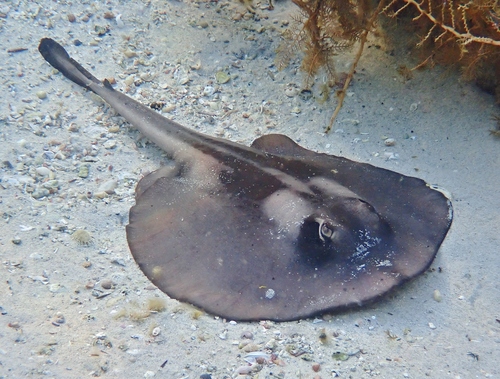
Striped Stingaree
Trygonoptera ovalis
Meet the masked marvel of the Australian shallows. With its signature eye markings and graceful, oval disc, the Striped Stingaree is a hidden gem of the coastal reef system.
Quick Identification
Size
Reaches a total length of up to 61 cm (24 in); the disc width is typically about half the total length.
Colors
Pale gray to sandy brown upper disc with distinctive dark, mask-like markings around the eyes and two dark blotches on the center of the back that transition into horizontal stripes.
Key Features
- Oval-shaped flexible disc
- Dark 'mask' markings surrounding the eyes
- Paired horizontal stripes extending from the center of the disc
- Small dorsal fin located just in front of the stinging spine
- Large leaf-shaped tail fin
When You’ll See Them
Behavior
The Striped Stingaree is a master of the 'sit-and-wait' strategy, often found partially buried under a thin layer of sand or silt. Unlike some of their larger open-ocean relatives, these rays are highly maneuverable and comfortable navigating the tight spaces found within rocky reefs and dense seagrass meadows. Their flexible pectoral fins allow them to 'walk' or hover precisely over the seafloor to investigate potential prey hiding in the substrate.
While generally solitary, they are not particularly territorial and may congregate in areas with high food density, such as around jetty pilings or in sheltered bays. They are relatively docile toward humans, though they possess a venomous spine for defense if stepped on or cornered. In the presence of a camera or observer, they tend to remain still, relying on their camouflage before eventually gliding away with a graceful, undulating motion of their disc.
EverydayEarth exclusive
Camera Tips
To capture the Striped Stingaree on camera, you will need a waterproof setup or a specialized underwater housing. For coastal residents with 'backyard' access to salt-water canals or beachfronts in Western Australia, the best approach is to mount your camera on a weighted baseplate or a short tripod that can sit firmly on the sandy seafloor. Aim the lens at a slight downward angle toward an open sandy patch adjacent to a seagrass line, as this is a high-traffic 'highway' for foraging rays.
Baiting is highly effective for drawing a Striped Stingaree into the frame. Use a perforated PVC tube or a mesh bag filled with crushed sardines or squid (burley). Secure the bait bag roughly 2-3 feet in front of the lens. The scent will travel with the current, and the stingaree will follow the trail to the source. They often spend several minutes hovering over the bait, providing excellent footage of their unique mask markings and the undulating movement of their disc edges.
Timing is critical regarding the tides. Set your camera to record during an incoming tide, which often brings cooler, clearer water and higher activity levels as rays move into the shallows to feed. If you are using a trail camera with a motion sensor, ensure it is designed for underwater use, as standard PIR sensors do not work through water. Instead, use 'time-lapse' mode set to intervals of 10-30 seconds to ensure you catch the ray as it glides by.
Lighting can be tricky in the surf zone. Avoid placing the camera facing directly into the sun (upward). Instead, position it so the sun is behind or to the side of the camera to illuminate the intricate patterns on the ray's back. In deeper or murkier water, a wide-angle lens is essential to get close to the subject and minimize the amount of particulate matter between the lens and the ray, which can cause 'backscatter' in your images.
Similar Species
Species that look similar or are commonly confused with Striped Stingaree.
Frequently Asked Questions
Record Striped Stingaree at your habitat
Connect a camera to start building your own species record — AI identifies every visitor automatically.