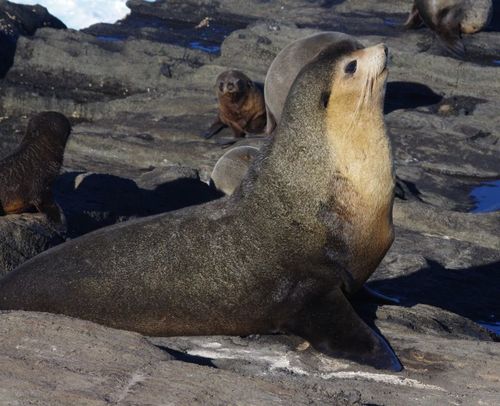
Subantarctic Fur Seal
Arctocephalus tropicalis
Meet the most stylish resident of the southern shorelines, famous for its creamy-orange 'tuxedo' chest and impressive mohawk. The Subantarctic Fur Seal is an agile acrobat that turns rugged volcanic rocks into its personal playground.
Quick Identification
Size
Length: 1.2-1.8 meters (4-6 feet); Weight: 30-160 kg (66-350 lbs)
Colors
Distinctive creamy-orange to yellow face, throat, and chest; dark brown to charcoal-grey back and flippers.
Key Features
- Sharp contrast between light-colored face/chest and dark body
- Prominent external ear flaps
- Short, flat muzzle
- Adult males have a visible tuft of fur or 'mohawk' on the crown
When You’ll See Them
Behavior
Subantarctic Fur Seals are remarkably agile and social pinnipeds, known for their ability to navigate rugged, rocky terrain that would stop most other marine mammals. Unlike many seals that 'galumph' on their bellies, these fur seals use their powerful hind flippers to walk or even run across boulders. They spend a significant amount of time on land 'hauling out' to rest, groom their thick underfur, and socialize, often choosing spots where they can catch the sun while remaining close to a quick escape into the surf.
While they are generally curious and may watch observers with wide, dark eyes, they are highly territorial during the summer breeding season. Adult males, or 'bulls,' defend specific stretches of shoreline with guttural barks and aggressive lunges. They are deep-sea foragers by nature, often diving hundreds of feet at night to follow the vertical migration of prey toward the surface. Despite the 'tropicalis' in their scientific name, they are cold-water specialists, perfectly adapted to the frigid winds of the southern oceans.
EverydayEarth exclusive
Camera Tips
To capture high-quality footage of Subantarctic Fur Seals, your camera placement must account for the harsh, salt-heavy environment of the shoreline. Position your camera on a low-profile mount or a weighted tripod tucked between rocks, approximately 18 to 24 inches off the ground. This 'seal’s-eye view' provides a much more intimate perspective of their facial expressions and movement compared to a high-angle shot. Because these animals frequent 'splash zones,' using a camera with an IP67 weather rating is essential, and applying a rain-repellent solution to the lens cover will prevent salt spray from drying into obscuring white spots.
Target 'haul-out' trails—the visible paths where the rocks look smoothed or polished by generations of seal traffic. These seals are surprisingly fast, so set your trigger speed to its fastest setting (ideally under 0.2 seconds) and use a high-speed burst mode of 3-5 photos to ensure you catch the moment they are mid-hop. If your camera supports video, 30-second clips are ideal for capturing their unique vocalizations and grooming behaviors. Avoid using white-light flashes which can startle the animals; instead, rely on high-output 'No-Glow' infrared LEDs for nighttime monitoring, as these seals are often active under the cover of darkness.
Timing is everything for the best lighting. The golden-orange fur on their chest is most vibrant during the 'Golden Hour'—the hour after sunrise or before sunset. Try to orient your camera facing away from the sun (North or South depending on your hemisphere) to avoid lens flare while maximizing the light hitting the seal's face. While you should never bait these animals with food, you can sometimes attract their curiosity by placing a brightly colored, sea-safe object (like a buoy) near the camera's field of view, as young seals are naturally inquisitive. Always ensure the camera is placed at least 15 feet away from known pup 'crèches' to avoid disturbing the mothers.
Similar Species
Species that look similar or are commonly confused with Subantarctic Fur Seal.
Frequently Asked Questions
Record Subantarctic Fur Seal at your habitat
Connect a camera to start building your own species record — AI identifies every visitor automatically.